Friday links! Grieving chimps edition

I had a picture of Halloween sausage costumes, but you know what's really spooky? We're all going to die eventually. Now go ahead, kids—take one piece of candy each.

I had a picture of Halloween sausage costumes, but you know what's really spooky? We're all going to die eventually. Now go ahead, kids—take one piece of candy each.

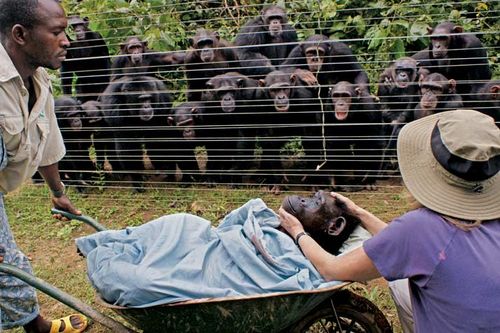
The photo at left was sent to me by alert reader Ben Fowlkes, whose near-constant cruising for chimpanzee snuff movies on the internet is interrupted only by his cruising for chimpanzee snuff porn movies on the internet. National Geographic published this photograph of Dorothy, a female chimpanzee in her late forties who died of congestive heart failure. According to the NGM blog, the other chimps in the Sanga-Young Chimpanzee Rescue Center gathered to watch her burial in eerie silence. “If one knows chimpanzees, then one knows that [they] are not [usually] silent creatures,” said photographer, center volunteer and typographical error Monica Szczupider. Dorothy was a maternal figure for many of the residents of Sanga-Yong, which rehabilitates chimps traumatized by habitat loss or the African bushmeat trade. It would appear that the chimps pictured above are grieving. Next time someone smugly refutes Darwin’s theory of species differentiation through natural selection by pointing out that his grandma wasn’t an orangutan, viewing this picture gives you legal grounds to slap him in the mouth.

Continue reading

Balwinder Singh, rookie American

Conclusive, blurry evidence that there is a man named Balwinder Singh driving a cab in New York City, and I am not a liar. In this case.

Conclusive, blurry evidence that there is a man named Balwinder Singh driving a cab in New York City, and I am not a liar. In this case. Props to Mike Sebba for the photo.

A year ago at this time, I was a tutor for prep school kids in New York City. In that capacity I took a lot of cabs around the Upper East Side, and one night I found myself conducted down Fifth Avenue by a man named Balwinder Singh. In New York, unusual cab driver names are something of a collector’s item. You can tell the people who just moved to the city, because they will sit down at the bar and excitedly tell you that they were just driven there by Muhammad Ali—not realizing that Muhammad Ali is the Harry Johnson of New York cab driver names: kind of funny, yes, but also too common to remark upon. After you’ve lived there for a few years, Muhammad Ali becomes just another fixture in the background of the city, like the Empire State Building or human suffering. To impress the true connoisseur of foreign cabbie names, you need something genuinely weird—like a Sherpa Sherpa, say, or a 45 year-old man named “Ball-winder,” who has unwittingly immigrated to a country where that is completely hilarious.

Continue reading

David Brooks and the nihilism of contemporary conservatism

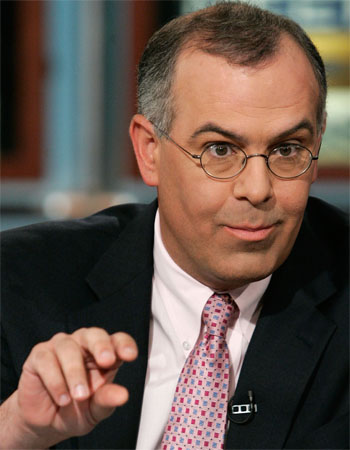
OM NOM NOM NOM NOM. OM NOM NOM. I know we've used this photo before—with basically this joke—but it pleases me so.

Seriously, does anybody want it? I'm going to eat it if nobody wants it. Michelle? You've had two already. Okay, we'll cut it in half.

Don’t get me wrong: I like David Brooks as much as the next guy. I realize I sound like I’m about to tell a David Brooks-ist joke—and if my grandpa asks you how you keep David Brooks out of your watermelon patch, just don’t respond—but I really do think that he provides sober, interesting analysis on a fairly consistent basis, provided that basis does not occur during campaign season, when he becomes insane. Generally, though, he’s a reasonable man. He employs logic and persuasive rhetoric in his columns, as if he were addressing people who did not necessarily agree with him before they started reading, which makes him something of a rarity among commentators on the right. As a result, his lucidity affords a valuable insight into the reasoning behind contemporary conservative thinking—a reasoning that is often obscured in the provocative (read: insane) rhetoric of a Beck, a Limbaugh or a Malkin.

Still, just because it’s valuable insight doesn’t mean it won’t be sad. Brooks’s column in today’s New York Times, in which he criticizes the Obama administration’s decision to limit executive compensation at banks and investment firms that received federal bailout money, exposes the nihilism at the heart of contemporary conservatism. Worse yet, it contradicts what he was saying one year ago at this time.

Continue reading

Obama forces Beck to oppose volunteering

httpv://www.youtube.com/watch?v=PQVqIpqA80Y

Remember the Superman cartoon where Bizarro Superman is running wild in Metropolis and nobody can figure out how to stop him, until Superman realizes that Bizarro will automatically oppose anything Superman says or does, so all he has to do to save the city is tell Bizarro he loves him? It’s possible that was just a dream I had, or an early-childhood experience. Anyway, Glenn Beck is the Bizarro Obama. If Obama says “Merry Christmas,” Beck has to wish us all a happy Fourth of July. If Obama likes cake, Beck has to go on TV and say, “No—me hate cake so much!” while eating handfuls of broccoli. It’s a professional obligation, and as the video above shows us, it sometimes puts him in a difficult position.

Continue reading

Friday links! Public option edition

Once you've made Lancelot Link: Secret Chimp, you don't really need to protect the dignity of the project.

Once you've made Lancelot Link: Secret Chimp, you don't really need to protect the dignity of the project.

It’s easy sometimes, when you’re sitting in Starbucks listening to the woman at the next table rhapsodize into her cell phone about Couples Retreat while her many children shriek and bat at each other’s genitals with rulers, to think that maybe you’re outnumbered. We at Combat! blog spend an unhealthy amount of time thinking about oppositional culture, and in that context one can fall into the trap of believing there is a massive, sluggish chunk of humanity arbitrarily opposed to anything one tries to accomplish. I mean, there is, but there aren’t as many of them as you might think.

Take the recent poll suggesting that 57 percent of Americans support a public health insurance option. After months of news telling us it was dead, of political analysts declaring that it was legislative poison, of John Boehner claiming he couldn’t find one person outside Washington who supported it, I was under the impression that, you know, people didn’t like it. It turns out that those who favor the public option outnumber those who oppose it by seventeen points—a margin far greater than the 53-to-49 margin Barack Obama enjoyed over John McCain in the popular vote. Of course, that was landslide victory; 17 points on a public option (or 30, in the case of states that don’t have affordable private options) is a slim margin to the national press. Which begs the question: Why isn’t the widespread pubic support for—and legislative opposition to—the public option the biggest news story in America right now? What happened to that liberal media bias I was raised on? Is it possible that the American people aren’t actually the problem with this one?

Continue reading