
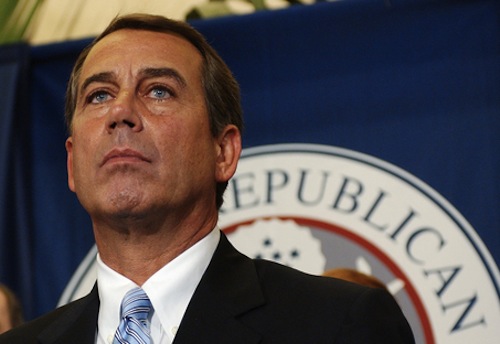
“It’s armageddon,” Boehner says; health care bill passes and “will ruin our country.”

House Minority Leader John "The" Boehner, who believes that words mean something.

I don’t know if you guys heard this, but the House of Representatives passed some sort of doctor bill last night. Assuming the President signs it—and does not just scrawl “Surprise, fuckers!” across the bottom before tearing his shirt off and tongue-kissing Michael Steele—the new law will remove lifetime caps on medical insurance payments, prohibit denials based on pre-existing conditions, expand Medicare to those 50 and older and, eventually, establish insurance exchanges that provide subsidized policies. I’m no lawyer, doctor, economist or constitutional scholar, but I think the implications are pretty obvious:

httpv://www.youtube.com/watch?v=xCZI3Z24mV8

And thus continue the circumspect deliberations of America’s legislative branch.

Continue reading

Friday links! Big important issues edition

From our friends at www.lamebook.com. Thank god they blur out the eyes, or someone might recognize this picture.

It’s Friday, and it’s not just the week that’s coming to an end. I don’t want to alarm you guys, but right now is the very last moment of recorded time. Terrifying, isn’t it? The pyramids, the rise and fall of Rome, the revolutions of the Enlightenment and the struggle against fascism, rock and roll, the Jackson 5, Friends—all that is over as of today. Everything is behind us, and we just don’t know what’s ahead. Frankly, this moment has never occurred before, so we don’t have much to go by. All I can say conclusively is that this has been a great week for hyperbole, absurd comparisons, and end-times pronouncements of all sorts. Fortunately, that’s just the kind of thing we at Combat! blog go in for. Incontrovertibly, this has been the last week in human history. Let’s all, like, gaze upon it.

Continue reading

Arguing over facts: House health care bill cuts deficit by $130 billion, maybe

A rare un-photoshopped image of Nancy Pelosi. Seriously, Google her and try to find a picture of her head not on a dog's body.

The Congressional Budget Office released its preliminary assessment (caution: boring) of the House health care reform bill this morning, and the news is good: if all goes as planned, the Reconciliation Act to HR 4872 and HR 3590 will reduce the deficit by $130 billion in its first ten years. Notice that I say, “the news is good,” and not “the news is good for Democrats.” Finding out that a plan to improve the general welfare might actually save us a bunch of money is nice; if you like the idea of poor kids having medicine but don’t like the idea of the United States becoming a wholly-owned subsidiary of China, the CBO report should be a load off your mind. Of course, if you’re some sort of professional demagogue whose opposition to health care reform has been based on the supposedly enormous tax burden it will place on your audience, it puts you in a tough position. Theoretically, you should change your mind—deficits bad: health care bad, so now deficit reduction good: health care good—but that would feel uncomfortably similar to being wrong. No, when your position suddenly stops lining up with the facts, your only option is to change the facts.

Continue reading

Steve King is a stupid man

Hi, I'm Steve King, and I'm an American just like you. My bathtub is ringed with toasters, and I once spent 13 hours lost in a revolving door. Who else wants pancakes?

Those of us from Iowa used to lament that our Republican senator, Charles Grassley, had become the face of opposition to health care reform. Why did the most recognizable Iowan in national politics have to be a wizened elf who accused every bill of providing free abortions to immigrants and kept assuring us that the Death Panels were in there somewhere? I, for one, wished that someone else—anyone else—could serve as Iowa’s delegate to the national imagination. That, boys and girls, is why you must never wish. Representative Steve King (R–IA) has fulfilled our longings in the most ironically disappointing way possible. Sure, Chuck Grassley is an asshole, a stubborn hick whose Twitter feed read “Barb made oatmeal,” on the day his committee abandoned the attempt to reach bipartisan consensus on health care reform. But yesterday Steve King called for the overthrow of the United States government. Apparently Congressman King has forgotten where he works, along with a bunch of other important information that might otherwise have allowed him to make a useful contribution to the operation of America. In speaking to the Huffington Post, he called for a peaceful takeover of Congress similar to Prague’s Velvet Revolution, and likened the state of our country to that of Czechoslovakia under Soviet communism. “It is very, very close,” he said. “It is the nationalization of our liberty and the federal government taking our liberty over.” Which raises a lot questions, not the least of which is whether Representative King knows what that word means.

Continue reading

Ethical dilemma of the day: hipsters on food stamps

At this point, the iconography of hipsterism has become so esoteric as to just be iconography itself. If your primary focus is your clothes and you still look terrible, you're a hipster. Photo courtesy of latfh.com.

Salon provides us with an interesting ethical question/reminds us of its existence today, with this article about hip, educated young people who use food stamps to buy organic groceries. Much to the consternation of Mose, hipsters have been a perennial object of fascination here at Combat! blog, in part because they’re so difficult to pin down. In reporting the apparent uptick in hipster consumption of Supplemental Nutrition Assistance Program benefit cards, Jennifer Bleyer acknowledges the difficulty of proving that what she’s writing about is actually happening. “The increase in food stamp use among this demographic is hard to measure,” she admits, “as they represent a cross section of characteristics not specifically tracked by the Agriculture Department, which administers the program.” When writing about hipsters, one must continually examine the possibility that they do not exist. For Bleyer’s purposes, the hipster is a fairly identifiable, if vague, marketing demographic: twenty/thirtysomething, college-educated, and willing to pay money for organic tarragon. In this case, the money is yours.

Continue reading