
Who is S.E. Cupp, exactly?

"Are you sure we should take the picture right now? It seems kind of windy."

In addition to being every woman I told myself I should just go over and talk to, SE Cupp is also a mystery. She’s a professed atheist who has written a book called Losing Our Religion: The Liberal Media’s Attack on Christianity. She’s just completed a master’s degree in religious studies at Columbia, and also just asserted her nonbelief on Bill Maher fifty times. [Warning: Maher at his most irritating.] She did the same thing with Sean Hannity, who insisted that she was actually an agnostic.* In an interview with the Daily Beast, she told Benyamin Cohen that ““I knew at a very young age that I didn’t really buy the whole God gamut.” She also told him that as a child she wanted to be a nun. Her columns for the NY Daily News—in which she argues that President Obama has not effectively wielded the power of fear and that we shouldn’t clean up the BP oil spill—suggest that she might simply be a contrarian. Yet she has built her career on aggressively upholding traditional beliefs. Let us not forget, when she argues that the news media naturally attack Christianity because “liberalism and secularism are the standards and anything that crops up against that are the exceptions,” that she is talking about a religion professed by nearly 80% of Americans.
Continue reading

Friday links! Kuleshov effect edition

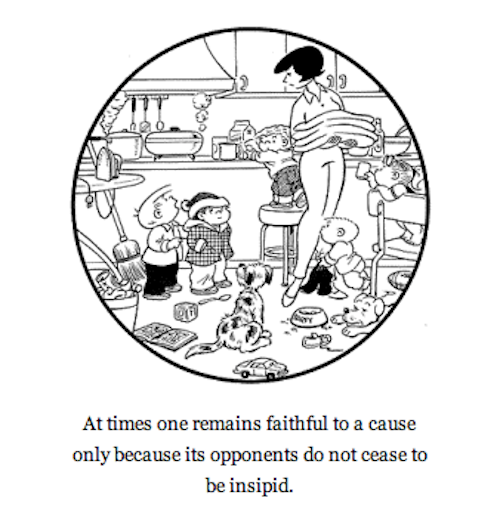
The image above comes from The Nietzsche Family Circus, which randomly pairs aphorisms from the German philosopher with drawings from the, um, insipid comic strip. You should check it out, provided you want to spend 40 minutes refreshing your browser and giggling uncontrollably. The NFC is an excellent example of the Kuleshov Effect, by which unrelated elements necessarily take on meaning in their juxtaposition. The Kuleshov Effect is why film editing works, and why young Billy/Friedrich Nietzsche seems to have perfectly articulated Thel’s existential despair above. It’s also the guiding principle of today’s link roundup, which features items from around the web united in their I saw them this week, but which seem to take on a vague, ephemeral narrative as a group. Sit back, crack open a beer (be sure to cough over the sound if you’re at work) and enjoy the fundamental human impulse to create meaning.

Continue reading

Specious trend of the day: icing

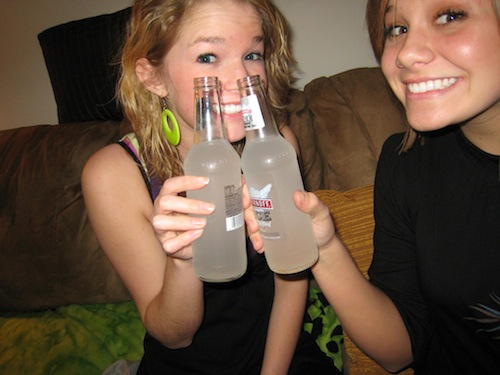
Actual trend of the day: 17 year-old girls drinking sugar liquor

Because I am very old, I read the New York Times in order to keep up with various social trends. It’s a little like reading Madeleine L’Engle to keep up with developments in contemporary physics: one encounters compelling stories, if not reports of, you know, this world. Tuesday, the Times turned the tables on its old adversary reality with this article about icing, which suggests that the trend—of which actual evidence exists, for once—may itself be artificial. It’s a Times trend piece in reverse: the people doing it believe in it, and the newspaper thinks it’s made up. But I’m getting ahead of myself. The reader not wearing flip flops and a khaki visor may ask, what is icing? To which I reply: take a knee, bro.

Continue reading

Great year for dead billionaires, trouble for us

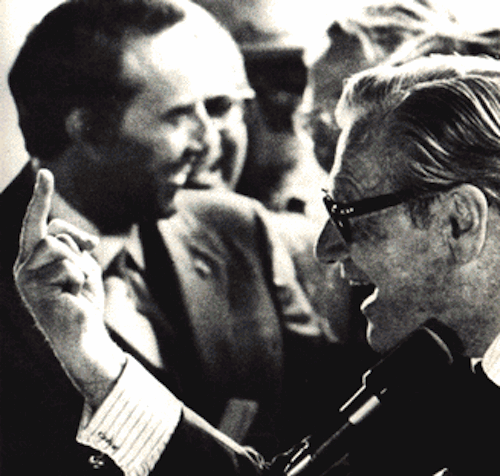
Nelson Rockefeller addresses himself to student demonstrators in 1970.

Hey, remember the estate tax? That bogeyman of the Bush years—the injustice enshrined in the federal tax code that robs hard-working Americans of their right to establish multi-generational dynasties as the Founders intended? The death tax? It’s possible you’ve forgotten it because it only applies to estates valued above $3.5 million dollars, and like most Americans you only stand to inherit, like, $3.2 mil. Then again, maybe you forgot it because it doesn’t apply this year.

Continue reading

Narrative watch: Obama isn’t angry enough at BP

Whatever you do, do not accidentally type "DP spill" into Google image search. I cannot emphasize that enough.

As the Gulf of Mexico slowly fills with crude oil and burned-off dolphin faces, forcing executives of British Petroleum to move their extra houses to the Pacific coast, an increasing number of Americans are putting the blame squarely where it belongs: on President Obama’s emotional experience. At least that’s what the news tells me. While attempts to cast the Deepwater Horizon spill as Obama’s Katrina foundered on the rocks of that makes no goddamn sense at all, the narrative that the President has displayed insufficient anger at the disaster has found a lot more traction. “Since The BP Oil Spill Began, President Obama Has Been Trying to Convey Presidential Action and Concern; But Is He Showing Enough Emotion?” CBS News asks.* Aside from the baffling meta-semantic demand that the President “convey Presidential action,” CBS pretty much captures the signature elements of the narrative. First, the President can’t really do anything. Second, if he doesn’t act more pissed off, people are going to think he doesn’t care. It’s an argument that presumes that Obama’s response to the disaster is reasonable, and also that people are too stupid to recognize it as such.

Continue reading