Was Bob Dylan racist in Rolling Stone?

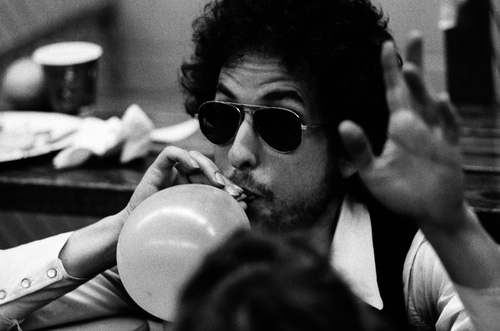
Bob Dylan prepares to say "sieg heil" in a hilariously high voice.

Bob Dylan prepares to say “sieg heil” in a hilariously high voice.

As white people, it’s our job to determine what is racist and what is not, since everyone else is biased. Fortunately racism is mostly over, so now it’s a matter of clearing up the fine points. For example: Bob Dylan is being investigated for inciting racial hatred in France as a result of comments he made in a Rolling Stone interview last year. But do the charges have any merit? Here’s some real talk from the man who wrote “Blowing in the Wind”:

If you’ve got slave master or Klan in your blood, blacks can sense that. That stuff lingers to this day. Just like Jews can sense Nazi blood and the Serbs can sense Croatian blood.

A Croatian community organization says Dylan’s remark was racist against Croats. But was it merely stupid?

Continue reading

Is our economy hostile to the humanities?

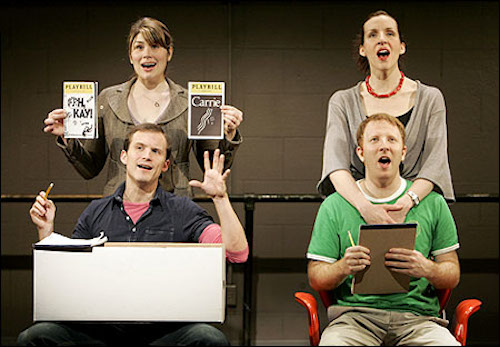
Wouldn't you rather watch this than a movie?

Wouldn’t you rather watch this than a movie?

Probably you scoffed at the headline of this post. Obviously, our contemporary economy is hostile to the humanities insofar as they include theatre and dance and, I dunno, edifying lectures on the origin of species. But from another perspective, culture is perhaps the most robust sector of the American economy. Pace niche competition from Bollywood and Chinese movies about kicking people, our film and television is the world’s film and television. Our music is the world’s music. These sentences will be included in a themed collection of Combat! blog posts that made Mose angry, but for the most part the United States has the strongest culture economy on Earth. But is our culture anywhere for a humanist to make a living?

Continue reading

Now busted, American Tradition Partnership does not exist

A weasel

A weasel

The last time we checked in with American Tradition Partnership, its attorneys were simulatenously disclaiming and demanding return of a box of documents found in a Colorado meth house that tracked the 501(c)4 organization’s coordination with Republican campaigns. Before that, they were publishing fake newspapers linking then-gubernatorial candidate Steve Bullock to sex offenders, and before that they convinced the Supreme Court to overturn Montana’s campaign finance laws per Citizens United. Last week, a district judge in Montana fined ATP over a quarter million dollars, saying it had shown “complete disregard” for those laws in 2008. But an attorney for ATP says the group is operatively defunct and “suggested it could be hard to collect any potential penalties.” The 2008 election was like five years ago anyway.

Continue reading

IRS plans new rules for 501(c)4 organizations

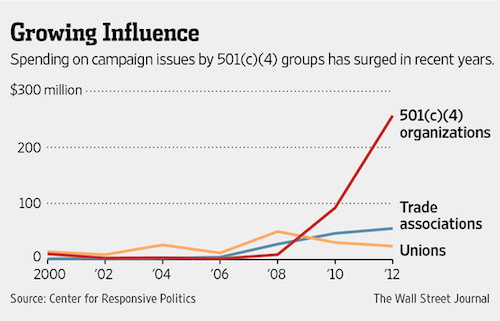
Political spending by tax-exempt groups over the last decade, according to the Center for Responsive Politics

Political spending by tax-exempt groups according to the Center for Responsive Politics

If you want to understand the problem of false equivalence in political reporting, consider this article from the Wall Street Journal about new IRS rules governing the political activities of 501(c)4 nonprofit organizations. The designation is intended for social welfare organizations, but it also covers the NRA and a slough of Tea Party groups, whose primary contribution to social welfare is relentless advocacy for their own legislative and political interests. As the Journal puts it in the story’s second paragraph:

Rules proposed Tuesday could at once help to curb the explosion in political spending by nonprofit groups, such as conservative heavyweight Crossroads GPS and the liberal Priorities USA, while setting clearer standards that could help the government avoid future dust-ups with politically active nonprofit organizations.

It sounds like Crossroads GPS and Priorities USA are two sides of the same dark-money coin, right? Except nine paragraphs later, we learn that Crossroads raised $180 million in 2011-2012, and Priorities raised $10.7 million.

Continue reading

Does the period convey anger in text messages?

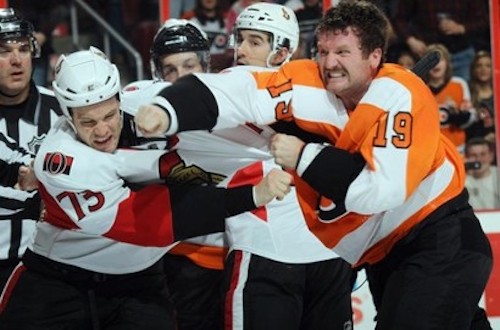
A hockey period, which is the third-angriest kind.

A hockey period, which is the third-angriest kind

Over at the New Republic, Ben Crair has written this consideration of why the period has become an angry punctuation mark. It’s a fun read, but I’m not sure I accept his premise. To wit:

The period was always the humblest of punctuation marks. Recently, however, it’s started getting angry. I’ve noticed it in my text messages and online chats, where people use the period not simply to conclude a sentence, but to announce “I am not happy about the sentence I just concluded.”

First of all, the comma was always the humblest of punctuation marks. People don’t have long discussions about whether to omit the period in any given sentence and then agree that it doesn’t matter. More importantly, though, is this subtle change in broad, undocumented patterns of usage real?

Continue reading