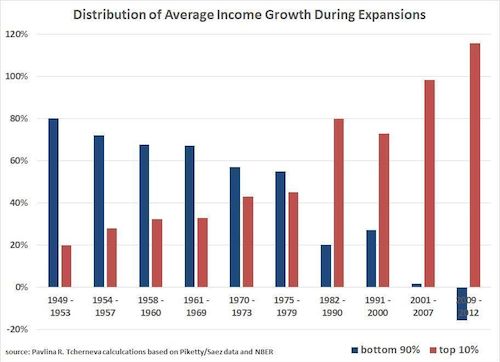
The Bard University economist Pavlina Tcherneva has calculated the distribution of income growth during periods of economic expansion, and her results suggest that recovery from the financial collapse of 2008 has been limited to the top 10%. It appears that more than all of the income growth since 2009 has benefited the richest tenth; during our glorious recovery, inflation-adjusted incomes have fallen for 90% of Americans. And don’t even get me started on 2001-2007, the period of wild growth in the finance and real estate sectors that set the stage for 2008’s crash. We saw six years of growth whose gains went to the richest Americans, followed by a jobless recovery that enriched them further at everyone else’s expense.

Author: Dan Brooks
Friday links! Propaganda states edition

A $2.5 million Bugatti with a penis painted on it. Can you spot the composition error in this photo?
According to a website called The LAD Bible, someone parked his Bugatti Veyron on the streets of Seattle, where someone else—presumably a rival Veyron owner—spray-painted a penis on the hood. The LAD Bible says that’s bad. Its 200-word article does not say who owns the car, the date this may have happened, whether the police are involved or how LAD Bible came to know about it, but it does describe the act of vandalizing a sports car as “unthinkable.” Today is Friday, and you don’t need a government to run your propaganda state. Won’t you relentlessly enforce the values of the ruling class with me?
Tired of winning votes, Montana GOP has plan to reduce them
Like many state GOP organizations since 2008, Republicans in Helena have a plan to fight voter fraud. The plan is to end voter registration before Election Day, so that people who go to the polls and find themselves ineligible to vote can’t just register on the spot. Since Montana implemented Election-Day registration in 2006, the secretary of state has documented two—count ’em: two—instances of unqualified voters knowingly casting fraudulent votes. Perhaps more relevantly, 29,000 Montanans have registered and voted on the same day—many of them students, senior citizens, returned members of the military, and other constituencies that traditionally vote Democrat. We must prevent these people from ruining our elections with their .0006% rate of fraud. If that means disenfranchising 2% of the electorate, so be it; I’m sure the Founding Fathers wouldn’t want those people to vote anyway. That’s the argument I make, tongue drifting into my cheek, in my latest column for the Missoula Independent. You should read it. We’ll be back tomorrow with Friday links.
National GOP group buys ad time in nonpartisan MT race
Kudos to The Missoulian for the stubbornly bland headline Independent Groups Raise Profile of Montana Supreme Court Race. That’s one way to describe what The Republican State Leadership Committee Judicial Fairness Montana PAC—catchy name, guys—did when it made this ad and bought $100k worth of airtime to support Supreme Court candidate Lawrence VanDyke in an ostensibly nonpartisan race. VanDyke’s campaign slogan is “following the law, not the politics.” It’s good he doesn’t follow politics, or else he might realize he was the object of partisan mendacity and get sad.
Pinker on how academic writing sucks, but maybe not why

Steven Pinker thanks you for coming to office hours, where something sexy could probably happen.
Now that we’ve all done our reading for today, I think we can agree that Pinker’s “Why Academics Stink at Writing” might be better titled “How Academics Stink at Writing.” The bulk of his essay documents the quirks and vices endemic to the genre; only in the last 500 words or so does he focus on the psychology behind them. The why of bad academic writing lives less in Pinker’s analyses than in the boldface headings he uses to taxonomize them: hedging, apologizing, “shudder quotes” (Pinker’s name for scare quotes,) et cetera. The insecurities these gerunds orbit help explain why a sentence trying to explain that people read statements marked true and false came out like this:
Participants read assertions whose veracity was either affirmed or denied by the subsequent presentation of an assessment word.
To oversimplify his argument, Pinker believes academics write badly because they’re scared.