
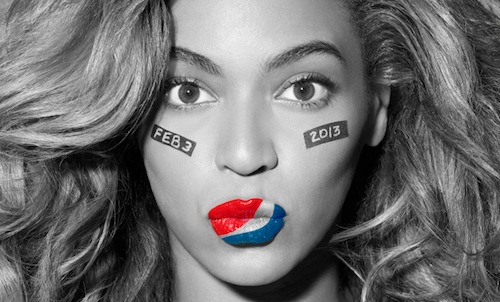
Pop star Beyoncé Knowles as literal mouthpiece
The aforementioned Mark Bittman—whose beans and greens recipe came out great last night, by the way—has used his Times column to call out Beyoncé for endorsing Pepsi. His intentionally provocative contention is that one day we will view sugary sodas as comparable to cigarettes in their impact on public health. Quote:
From saying, as she once did in referring to [Michelle Obama’s fitness initiative] Let’s Move, that she was “excited to be part of this effort that addresses a public health crisis,” she’s become part of an effort that promotes a public health crisis. I suppose it would be one thing if she needed the money or the exposure but she and Jay-Z are worth around $775 million.
Since we’re a bunch of grizzled old ethicists around here, I thought we might take up the question: Is it wrong for Beyoncé to sell her endorsement to Pepsi?
Before we get too deep into this one, I want to make something clear: I would sell my imprimatur/likeness/word to Pepsi for millions of dollars. So would you. Ours is the generation raised to criticize people for selling out, but if someone offers you an income-level quantity of money for your image rights, take it. I paraphrase John Calvin when I note that the world of work is so miserable a person should do anything he can to escape it. To criticize Los Campesinos! for selling their song to a Budweiser commercial is to argue that working at Starbucks is somehow not selling out. Better to sell your art—or the broader significance of your life—than the time you need to make it.
But this principle is moot when you are already freed from work, and as Bittman points out, Beyoncé is. The eleventy gajillion dollars she got for telling us to drink Pepsi goes into the already-enormous Sean Remembers Marcy Fund she shares with Jay-Z. While the rest of us might be forgiven for endorsing soda the way a French urchin might be forgiven for stealing a loaf of bread, Beyoncé is exempt from such sympathy in the same way as a multimillionaire pop star caught stealing a loaf of bread.
Still, three contingencies remain in which Beyoncé’s decision is ethically neutral. They are:
- Advertising does not make people drink a bunch of Pepsi.
- Drinking a bunch of Pepsi does not make you fat.
- It is okay to make people fat in exchange for money.
I would describe scenarios (1) and (2) as acquittances of responsibility. If celebrity endorsements do not influence people’s soda consumption habits, then A) Pepsi has the dumbest long-term strategy since Blockbuster and B) Beyoncé is merely accepting suckers’ money. Perhaps that is unethical, too, but a pop musician cannot afford to consider it. Likewise, if drinking a liquid that is 12% sugar does not adversely affect your health, Beyoncé is not hurting anyone. She is merely influencing people’s wills in exchange for money, which is creepy but no less ethical than being a maketing executive or a hypnotist.
The question implicated in scenario (2) is so complex that one can argue any answer to inconclusivity, but I suspect that Beyoncé does not drink Pepsi. Regardless of whether Bittman and others exaggerate the health risks posed by soda, the Queen Bee herself almost certainly does not have a Pepsi and a meatball sub for lunch. She has invalidated scenario (2) in her personal ethics, and by the same token she has also ruled out scenario (1). Beyoncé advertises her own music, and the arc of her career has surely made her aware of the value of image ubiquity. If she does not believe that her Pepsi endorsement will increase Pepsi consumption, then a large portion of her other behavior becomes inexplicable.
We are left, then, with scenario (3). Unlike the other two causal claims, the proposition that it is okay to make other people fat for money is an ethical claim that cannot be strictly proven or disproven. Most of us, however, have a visceral sense that such behavior is not okay. If you had a ray gun that made people gain weight and discharged twenties, it would be wrong to go to the mall and point it at strangers. You might argue that something is lost in the analogizing of a celebrity endorsement to a fat ray, but I submit that to do so is to make recourse to scenario (1) or (2).
The complexity of the advertising mechanism—as opposed to the simplicity of our theoretical fat ray—is that complexity which allows bad faith. Beyoncé can tell herself that she is not forcing anyone to buy Pepsi, or that a couple extra sodas during the Super Bowl is not a big deal, but in doing so she appeals to premises that she has already rejected. Yet the indirect mechanics of soda endorsement allows her to believe and simultaneously not believe them. It’s a free country, and nobody has to buy a Pepsi just because Beyonce told him to. We don’t even know if Pepsi makes you fat. Neither of these propositions holds up on its own, but as a matrix of uncertainties combined with millions of dollars, they provide a bearable level of excuses.
We are forced to conclude that Beyoncé should not have endorsed Pepsi, because she has to lie to herself in order to do it. Bad faith is the canary in the mine. We should not be too hard on her, though, for two reasons. First, I would almost certainly do the same thing in her situation. Pepsi has a lot of money. Second, she gave us this:
httpv://www.youtube.com/watch?v=4m1EFMoRFvY
It still gets me, even in Target.


Is it possible that rather than advertising for Pepsi, Beyonce thinks of this as advertising the Beyonce Brand? She needs to remain ubiquitous in order to remain relevant. This campaign puts Beyonce in our faces just as much as (actually more than) it puts Pepsi in our bodies.
This doesn’t change your points, but it does alter the equation.
Isn’t there a fourth contingency where ads for Pepsi only make people who chose to drink pop choose Pepsi over other brands rather than making them chose to drink pop over some other liquid? In other words, do McDonald’s commercial make us go to Burger King more than we would if the McDonald’s commercials didn’t exist?
I submit this question hinges on what she is endorsing. Beyonce is a pop star; her job description is essentially to be cool for money. She is not a medical professional. No-one is seeing this ad and thinking that Bey’s endorsement is contingent on the healthfulness of the product. She is just lending Pepsi some of her cool in exchange for a check. That doesn’t seem particularly troublesome. To be honest, I’d be fine with it if she endorsed Parliaments (someone please figure out a Single Ladies-Loosies joke to go here), assuming she didn’t claim they made her breath better or some other lie.
I’ll admit that I had a visceral reaction that a Pepsi-endorsement could not be immoral and worked backwards to figure out the logic. As a strong believer in the scientific method, I assume my logic has some serious holes, but what are comments sections for if not visceral claims with faulty logic?
Or perhaps, Beyonce should not have announced her support of Michelle Obama’s health programs. Maybe she doesn’t really support them, but just wants to be on good terms with the first lady
The most moral thing to do in her situation would be to take Pepsi’s money and donate all of it, very publicly, to programs to fight the scourges of obesity, diabetes, and premature death wrought by drinkable calories, and in particular, Pepsi. (BTW, yeah it’s a complex issue, but smart people are pretty fucking sure.)
ditto: Scott, which leads me to wonder exactly what the ad campaign is for Pepsi? Just an image? Or is there text/dialogue?
I believe the most moral way out of this predicament would be to take a route similar to that Most Interesting Man beer commercial. I believe the line, “I don’t always drink beer, but when I do, I drink…” absolves him of responsibility for others’ decisions to drink BEER (vs. water) and lends his (fictional) celebrity to drinking THAT beer (over, say, Porkslap.)
It might not be a TOTAL moral justification, but I think it is a reasonable escape hatch if called out.
Nancy has it right: this is an advertisement for Beyonce, paid for by Pepsi.
maybe mayor bloomburg was right, about the soda. how much has she been drinking?
wow that is a big woman. maybe she should cut down on the soft drink, and advertise for polar spring water. lol