
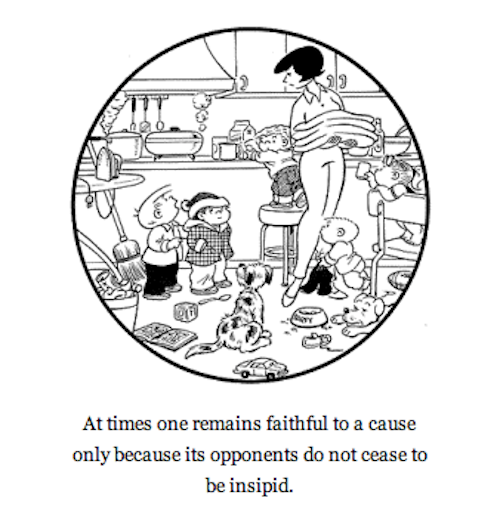
 The image above comes from The Nietzsche Family Circus, which randomly pairs aphorisms from the German philosopher with drawings from the, um, insipid comic strip. You should check it out, provided you want to spend 40 minutes refreshing your browser and giggling uncontrollably. The NFC is an excellent example of the Kuleshov Effect, by which unrelated elements necessarily take on meaning in their juxtaposition. The Kuleshov Effect is why film editing works, and why young Billy/Friedrich Nietzsche seems to have perfectly articulated Thel’s existential despair above. It’s also the guiding principle of today’s link roundup, which features items from around the web united in their I saw them this week, but which seem to take on a vague, ephemeral narrative as a group. Sit back, crack open a beer (be sure to cough over the sound if you’re at work) and enjoy the fundamental human impulse to create meaning.
Search Results for: times trend piece
Ethical dilemma of the day: hipsters on food stamps

At this point, the iconography of hipsterism has become so esoteric as to just be iconography itself. If your primary focus is your clothes and you still look terrible, you're a hipster. Photo courtesy of latfh.com.
Salon provides us with an interesting ethical question/reminds us of its existence today, with this article about hip, educated young people who use food stamps to buy organic groceries. Much to the consternation of Mose, hipsters have been a perennial object of fascination here at Combat! blog, in part because they’re so difficult to pin down. In reporting the apparent uptick in hipster consumption of Supplemental Nutrition Assistance Program benefit cards, Jennifer Bleyer acknowledges the difficulty of proving that what she’s writing about is actually happening. “The increase in food stamp use among this demographic is hard to measure,” she admits, “as they represent a cross section of characteristics not specifically tracked by the Agriculture Department, which administers the program.” When writing about hipsters, one must continually examine the possibility that they do not exist. For Bleyer’s purposes, the hipster is a fairly identifiable, if vague, marketing demographic: twenty/thirtysomething, college-educated, and willing to pay money for organic tarragon. In this case, the money is yours.
Advertisers create new, empty word: love
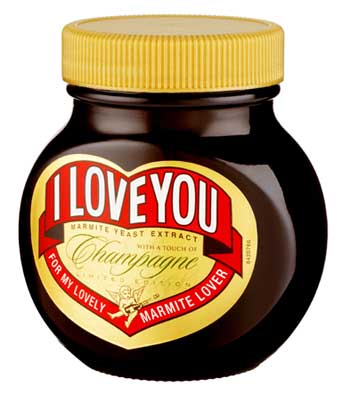
This jar of marmite yeast extract spread loves you. It also points out that part of being in love is expressing it physically...
We here at Combat! blog have criticized the trend reporting at the New York Times in the past, but all is forgiven with today’s fascinating piece about marketers’ rampant use of the word “love.” Okay, not all is forgiven—we’re still pissed about their expose on the horrors of the Park Slope Food co-op—but at least this one has some verifiable information. It turns out that the Times is at its best when it’s writing about advertising, and advertising is at its best when it’s convincing you that the most profound human emotional experience can be replicated by using a Blackberry. Car manufacturers seem to be the biggest purveyors of sweet nothings, here, with Honda, Subaru and Nissan all launching love-oriented ad campaigns in the last two years. The notion of people loving their cars is nothing new. Your car represents freedom, self-sufficiency, responsibility and socio-economic status, as anyone without a car will tell you. Anyone without a girlfriend will make a similar argument, so the connection between cars and love seems obvious—especially if you are dead inside. Consider the rationale offered by Michael Kuremsky, Vice President and Global Brand Franchise Leader at Olay: “We view Olay as a partner alongside women, so the emotional connection is Olay validating to a woman that we want to help her achieve her best skin, to get to a place where she loves her skin.” Tonight, darling, I will take you on a carriage ride around Central Park and validate that I want to partner alongside you in achieving your best handjob, ever.
Friday links! Relentless march of time edition
 Another year is slowly—dare I say tediously?—drawing to a close, and the air here in the Combat! blog offices has taken on a philosophical tang. Maybe it’s the nostalgia of the Christmas season. Maybe it’s the end of an undeniably weird decade. Maybe it’s that we’re 32 years old and spend almost every night alone reading the Meditations of Marcus Aurelius in our house in the mountains. Probably it’s something you did. The point is, time moves forward with the inexorable confidence of like a time train or something, and we mortals can only note its passage. Change wins the day with the coming of every night, and the only certain thing in our lives is that each of us will eventually die. In the meantime, we have trend pieces. Won’t you join me in the news of the day? Who knows—it could be your last. Merry Christmas, everybody!
Virtual fashion economy booming, says virtual news story

In real life she's an utterly empty shrew, too, but kind of fatter.
The copy of a screenshot of the virtual version of a person at right is Angie Mornington, host of a weekly fashion show on Treet TV, the television station of the avatar-driven social networking platform Second Life. I find that sentence confusing, too. If you want to depress yourself, think about how 15,000 people a week use their fantasy lives in a 3-D computer world to watch television—and the virtual television equivalent of The Home Shopping Network, at that. If you want to depress me, point out how that’s about 300 times the readership of my blog.
All this information—okay, not the last sentence—comes from a trend piece in today’s Times about luxury spending in virtual worlds like Second Life, There.com and IMVU. For those of you unfamiliar with the ever-narrowing canyon between geek and sexual fetish culture that is Second Life, it’s a free-form, virtual world in which players own land and consumer goods, run businesses, interact socially and live out lies of computer-modeled desperation through their avatars, which are invariably both disturbing and attractive in roughly the same way as Angelina Jolie. Membership in these sites is free, but the money you spend there—Lindens in Second Life, Therebucks in There—has to be purchased with actual United States or foreign currency. Which—especially after you hear that such virtual worlds enjoy economies whose “avatar-to-avatar transactions [are] estimated at between $1 billion and $2 billion a year in real dollars,”—begs a question: Why?