
The Chinese stock market did something weird, you guys

As you would know if you weren’t so preoccupied trying to choose worst crab, Monday was the 23rd anniversary of the Tiananman Square massacre, when the Chinese government rolled out tanks to quash pro-democracy demonstrations and killed several hundred protestors. They don’t like to talk about it. “They,” in this case, means the leaders of whatever weirdo system of government used to be run by the Chinese communist party, now the fabulously wealthy leaders of a billion-person market police state. When “they” refers to the Chinese people, they would like to talk about stuff like Tiananmen Square a lot. That’s why they/they were delighted/alarmed when the Shanghai Stock Exchange fell exactly 64.89 points on Monday, evoking the date 6/4/89.

Continue reading

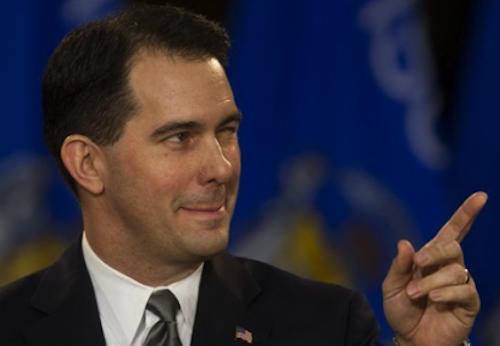
In torrent of money, Scott Walker floats

Human gestures developed thousands of years before still photography.

The recall votes are in, and Scott Walker has easily remained governor of Wisconsin. Walker won by seven points over Milwaukee mayor Tom Barrett, who is the same person he defeated in the election of 2010. Let it never be said that the Democratic Party is a political slug who believes its moral superiority entitles it to win elections simply by not being the other guy. Wait, I did that wrong—let it always be said that thing about the slug. There is a silver lining in the Wisconsin Democrats’ plan to do the same thing and get different results, though. Two elections between the same two guys two years apart give us a rare opportunity to isolate variables, and there happen to be two things different about Walker vs. Barrett 2010 and Walker vs. Barrett 2012: The Rewalkering. One, the Supreme Court declared limits on corporate political spending unconstitutional in Citizens United v. FEC. Two, the first Walker/Barrett tilt cost $18.9 million, whereas yesterday’s recall cost $63.5 million.

Continue reading

NC bill would outlaw sea level estimates

Downtown Durham

If you have a cat, make sure he is not sitting on your lap when you read this article about the North Carolina legislature’s plan to make exponential sea level projections illegal, lest the rage beam that shoots out of your face fill your home with the smell of burning hair. As everyone’s grandfather taught them, there are two ways to project future sea levels. One is to make an exponential model based on expected climate phenomena and rates of increase from recent years using math and scientists and stuff, and the other is to make a line graph based on sea levels from the last hundred years. As you might expect, the method that expects next year’s increase to be the same as in 1902 yields a much lower number, since it disregards global warming. “We’re skeptical of the rising sea level science,” says Tom Thompson, who just happens to be chairman of an economic development group representing 20 of North Carolina’s coastal counties.

Continue reading

Montana governor on money in politics

Governor Brian Schweitzer of Montana, wearing the legally mandated bolo tie

Say what you will about Montana—where, for example, the most liberal city in the state does not provide garbage pickup—we do preserve a certain political culture. The same Montana that devotes very little money to public services and has a legislature that meets for 90 days every other year was also one of the first states to legalize medical marijuana. When I first came to grad school here, it was legal to drink whiskey straight out of the bottle while driving on the interstate. Like the great libertarian states, Montana is suspicious of pretty much all laws; yet, like the great liberal states, it is also suspicious of corporate influence. Montanans are just suspicious generally. That’s why we have some of the tightest campaign finance restrictions in the country, and why Governor Brian Schweitzer took the New York Times yesterday to defend them.

Continue reading

Friday links! Apocalypse nowish edition

The four horsemen of the apocalypse: war, famine, disease, and tweets as sources

I’m not saying that the apocalyptic destruction of goodness and the unraveling of sense are in the near future, but what are the odds that they’re in the recent past? The anthropic principle dictates that the apocalypse is coming, because if it had already happened we wouldn’t be here. Ergo, pretty much every event is a sign of the coming apocalypse, or at least a link in the causal chain. We just have to figure out how to read them. Today is Friday, it’s pretty gray outside, and there seem to be an inordinate number of cannibal stories floating around. One need only check the news to find ample evidence—or at least some pre-schizoid pattern recognition—for the end of days. Come scry with me, won’t you?

Continue reading