

Friday links! Windy everyone edition

Combat! blog is in Chicago, a fine city with an eerie surfeit of lofts and bagels. It’s like New York if a coalition of white people got together to construct a replica of New York, although it’s possible I suffer a bias of perspective. A city is all in how you see it. So is an idea: you frame a truism like “it’s all in how you see it” with a specific context, like a city or a world-historical narrative, and suddenly a rusty old saw seems gleaming and sharp. When it comes to clichés, it’s all in how you see it. This week’s link roundup is A) half-assed—possibly even quarter-assed—and B) about how we see things. Sometimes that’s literal. Other times it’s absurdly, horribly figurative. Won’t you abandon yourself to a directionless relativism with me?

Continue reading

Combat! blog flies through air, isn’t useful

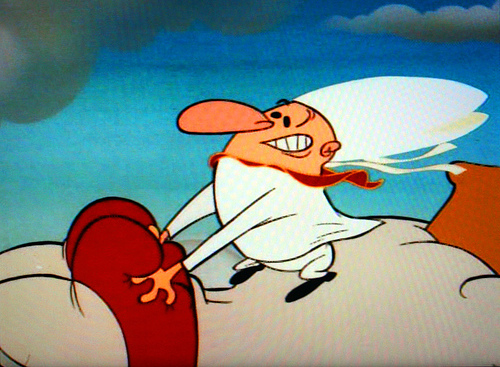
Frank Zappa was the voice of the Pope in that episode.

There is no Combat! blog of value today, because I am flying to Chicago. While I steep in baby germs, why don’t you watch this panel discussion on filmmaking with the Coen brothers, moderated by Noah Baumbach. It’s an hour long, which is way more enjoyment than you would get out of a regular blog post anyway. We’ll be back Friday morning, probably in extremely half-assed fashion and eating enormous hot dogs.

Too big to punish?

Charles Holliday, Chairman of the Board of Bank of America

The City of Baltimore has filed a lawsuit in Manhattan federal court, alleging that banks deprived the city of millions in investment income by conspiring to fix the London interbank offered rate. Stay with me. Like all aspects of banking except robbery, the Libor is extremely boring. It is the benchmark interest rate at which banks loan money to one another, and it provides the basis for interest calculations on a variety of investments, loans and other financial instruments. When the Libor goes up, banks pay more for cash flow loans, and some investments yield more. When it goes down, banks pay less and some investments yield less. According to Peter Shapiro, an advisor to Baltimore and other municipal investors, “about 75 percent of major cities” have lost money due to Libor manipulation.

Continue reading

Romney keeps it surreal in the Hamptons

“We removed it to make his mouth more efficient!”

My favorite aspect of the 2012 presidential election is the micro-genre of news story in which Mitt Romney does some Richie Rich shit. This weekend was delightful, as Romney held a trio of fundraisers in the Hamptons. You may remember the Hamptons from such experiences as client invites you to his summer home to reinforce the idea that he is your boss, or this. That was hilarious when I was twelve, but now that I am older I prefer the sort of sardony you can only get from the New York Times:

A woman in a blue chiffon dress poked her head out of a black Range Rover here on Sunday afternoon and yelled to an aide to Mitt Romney, “Is there a V.I.P. entrance. We are V.I.P.” No such entrance existed.

Well played, Michael Barbaro and Sarah Wheaton. But for the prize pig Romney donor quote of the weekend, you’ll have to click on the jump.

Continue reading

Shamus Khan on cultural elitism

“Well-known” does not influence photo quality when attached to “sociology professor.”

Shamus Khan’s opinion piece about “The New Elitists” initially made me angry. Sure, I enjoyed the sweet anecdote about William Vanderbilt getting snubbed by the New York Academy of Music, and I’m always up for a screed against the rich. The rich are given resources out of all proportion to their talent and usefulness, usually by their parents. It’s a peculiar way to run a country that defined itself against inherited aristocracy, although it makes more sense if you think of the United States as the country that defined itself against Marxism. My complaint is that Khan focuses his column on cultural elitism—the “omnivorousness” that passes for sophistication but is often simply the hallmark of privilege. I consider myself a cultural omnivore. I like Sean Paul’s art and Jean Paul Sartre. Must I therefore be an elite?

Continue reading