
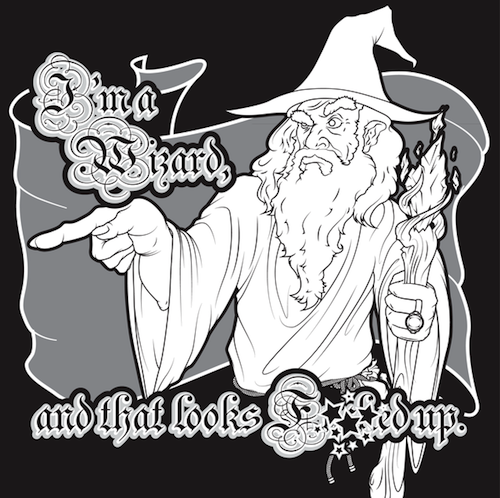
Since the US government and most history ground to a halt over the weekend, I’m going to take a moment to address one of the comments on Friday’s links. I’ve gone back to reading the comments, because Aksimet cannot be trusted to distinguish rap videos from Cialis advertisements on its own. Anyway, Matt offered the following question about the Dungeons & Dragons spell Wish:
Isn’t wish open to the DM’s interpretation? Like if you wish for a meteor to crush your enemy, the DM can also have the meteor crush you? Or were my friends just major douches?
“Or,” huh? The theme of today’s post is don’t make me choose.
Let’s lay some premises first: obviously this topic is very important; when I say “Dungeons & Dragons” I mean “Advanced Dungeons & Dragons,” and I stopped playing between the 2nd and 3rd editions. I still refer to wizards as “magic-users,” a term Gary Gygax adopted to stop people from thinking his game would be fun. My anachronism is going to be important to anyone looking to catch me in technical misstatements about the rules, as well as to those who mistakenly believe that this theoretical discussion of a 20 year-old version of a role-playing game is not important. You guys fail your saving throws and are asleep now, so be quiet.
For the rest of us, who are normal: yes, Wish is open to dungeon master interpretation. If you are a dungeon master and have somehow allowed your players to reach level 20—possibly by starting them all at level 18—Wish is going to cause a lot of problems with your game. Casting it will age their characters three years, but that is not likely to deter players from using Wish to remake your fantasy world as they see fit, because the first time they cast it is the first time they heard anything about having an age.
So you will need to restrain your players’ wishing. One way is to limit the scope of Wish, as subsequent editions of the game did. As Matt reminds us, another and more popular approach is to grant the literal text of wishes in figuratively diabolical ways. For example, if a character wishes for a +5 sword with vorpal blade, that sword may come to him in the belly of the Tarrasque. Then he will wish he kept his Wish to make the Tarrrasque stop regenerating. In this way, player wishing can be corrected.
I daresay that there are two kinds of Dungeons and Dragons games, and by far the more numerous is the kind where any Wish is an occasion for disaster. My childhood game was of that sort, and it affected my worldview. Imagine a realm of fantasy, where anything is possible. Imagine within that fantasy a mechanism for making even more things possible. Now imagine that your logical interpretation of increased possibility is to multiply the trouble in the world.
I mention this because I recently read the New York Times obituary of one Barnaby Conrad, bullfighter and author. Surely, the Times’ are the only obituaries that consistently provoke envy. Also, Conrad got into bullfighting at age 19 after attending an event in Mexico City where, on a whim, he “leapt into the ring and challenged a bull himself, using his Brooks Brothers raincoat as a cape.”
Now there is a man who had not seen past wishes granted in diabolically ironic ways. He was at a bullfight and figured he would try fighting a bull himself—because what’s the worst that could happen? In this case, he became a pupil of Felix Guzman the matador and went on to fight more than 40 bulls in Spain. He also wrote 30 books.
The almost comically life-determining consequences of Conrad’s impulse to jump into a ring and taunt a bull with his raincoat remind us that the present moment is a wish that must be made and will be granted. One might argue that it is the constrained Wish of later editions, but I submit that the constraint lies not so much in possibility as in the specificity required to make the wish come out right. If your wish is to become a bullfighting author, you have to put a lot of scrying into determining which action in the present moment will accomplish that, but it’s still a reasonable investment compared to becoming a level 20 wizard.
Or you can wish wildly and see what happens. I personally was inoculated against this method from an early age, but history shows us that it often works. Or it rarely works, but when it does we hear about it. In any case, a thrilling world where anything can happen is exactly the game we have been given. Whether the DM is particularly stern or not is anyone’s opinion, but you cannot deny that options are available.


I had to take a break after the second paragraph because I’m reading this in a public place and laughing at a computer screen is still oddly inappropriate.
“The present moment is a wish that must be made and will be granted.”
Did you crib this from somewhere else, or just invent something brilliant?
I nearly commented last Friday that I once wished for a vorpel sword, which flew through the sky and decapitated my warrior companion. This caused the owner of my warrior companion to do some real life nose pounding on me at a later date. Why kick my ass, you/I might ask/asked? Because I did the wishing, and our DM was a bastard. I should have known better. Also, as I recall with that particular vorpal sword, rolling a 20 meant instant decapitation of my opponent, but rolling a 1 meant I had just cut off my own arm. So, yes, in my experience, most DM’s are power hungry douches, ala, Tommy Carcetti in The Wire.
But don’t take my word for it. Here’s a link to a cool story by Sam Lipsyte (whose work I personally enjoy) from a few years ago entitled “The Dungeon Master”:
http://www.newyorker.com/fiction/features/2010/10/04/101004fi_fiction_lipsyte
Tommy Carcetti was not a power hungry douche. Did you mean to type Marlo Stanfield? Carcetti was a typical politician, someone who wanted to, and believed he could, solve a specific problem or two, who was corrupted by a system which prevents individuals from single-handedly acting on an agenda. Everything in governance requires a coalition, and building coalitions means compromising. Giving people want they want in order to join that coalition is “corruption.” But it’s how the system is designed, and Carcetti is supposed to demonstrate that, since even at his stats-bending worst, he never goes beyond political realities into actual malice or incompetance.
Spoiler alert: There are no characters in The Wire who are power hungry douches. The characters are a palette of shades across the individualistic/moralistic spectrum. Some, like Stringer Bell, Jimmy McNulty, and Omar Little are highly individualistic. They seek to go around or through the systems around them. They are innovative. Others, like Avon Barksdale, Kima Greggs, and Bubbles, try to support the system. They would rather work from within it to attain personal happiness or positive outcomes for the people around them. They are incremental.
Every character has flaws and good inside him or her. Every character has strengths and abuses something outside him or her. There are no power hungry douches, the closest, again, is Marlo. His power hungriness is a personal flaw, and perhaps treated less sympathetically than anyone else who demonstrates power worship like every officer in the police department. Marlo’s quest for power is the closest place to one-dimensionality in the show. Everywhere else, if you find yourself describing a character as a ______ douche, you’re missing the point.
I wrote an essay. It’s in the spam bin.
I always thought Wish required a long conversation with a Djinn, and a lot of difficult Wisdom checks (not a quality of many high level magic users) in order to get what you wanted.
Actually, Attempt, I know the difference between Carcetti and Marlo. We can agree to disagree regarding Carcetti. I honestly can’t tell what motivates him, and that’s what I find fascinating about him. Initially, I thought he was an idealist, but after my fifth viewing of the show, I’m not sure. I can’t tell which, if any, are his honest moments. Does he want to fix the city or is he, as Burrell suggests early in the third season and Carcetti affirms, simply bored?
As for there being no power hungry douches in The Wire, (spoiler alert!) did you know there’s a fifth season? How about Scott Templeton who’ll write anything to get a job at the Post? What about Whiting whose sole ambition is to win a Pulitzer and transfers Alma when she brings him Scott’s blank notebook? What about Klebanow, a character based on David Simon’s former editor at The Sun, Bill Marimow, a man Simon despises so much they still trade vitriolic tweets decades later?
To me, that’s why that season doesn’t live up to the others; many of those characters in the newsroom turned flat. They were unredeemable, predictable and uninteresting.
Anyway, my apologies for not having a more nuanced opinion of Carcetti. If it’ll prevent a gushing of future sanctimony on your part, I promise to view The Wire through the Attempt lens and no other.
I am genuinely grateful to the holder of this web site who has shared this impressive article at here.