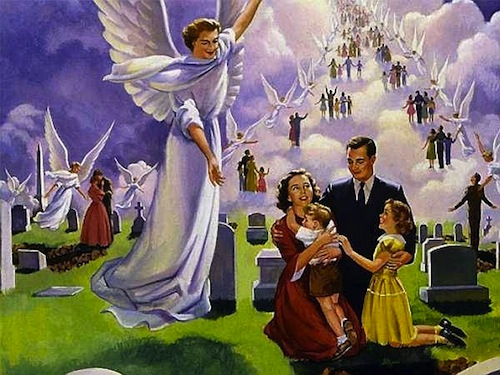
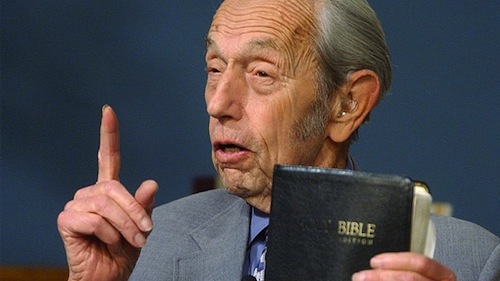
A fun thing to do Saturday was warn your friends about the Rapture predicted by evangelical minster/probable crazy person Harold Camping, then watch as they ascended into heaven got drunk and talked about their dads like usual. Camping performed a series of numerological calculations based on scripture to predict the end of the world to the day, apparently on the assumption that A) neither he nor a 2000 year-old account written 250 years after the fact could possibly be wrong about the day of the week on which Jesus was crucified, or B) there was no way he’d live that long. It’s also possible he realized C) he could always lie about it afterward, in a sort of Rapture-predicting encore. God never closes a door without opening a window,*

and Harold Camping now assures us that the Rapture he predicted did happen, but it was invisible. The world will actually end on October 21, exactly six months after the date he originally predict—dammit!

Close Readings: Sarah Palin’s view of expertise

"Are you going to stand there babbling about what carbon does, or are you going to get the first woman president a fuckin' Jamba Juice?"
There is much to enjoy, guiltfully, about this review of Blind Allegiance to Sarah Palin, the tell-all book by former staffer Frank Bailey. Memoirs like his threaten to become an ugly micro-genre of an already ugly mini-genre, but there is something in the essential sameness of Sarah Palin Stories—the pride in ignorance, the deceptions of others en route to self, the different supporting characters in the same vexed orbit around our heroine—that suggests a form whose themes transcend detail. They’re like Sherlock Holmes stories. As Holmes was to Victorian London and solving crimes, so is Sarah Palin to suburban America and being a mindless church bitch. What I’m saying here is that I think here oeuvre is more than genre work. That’s good news for Close Readings, which received from Stubble yesterday this wonderful gift:
Remember: amateurs built the ark. Professionals built the Titanic.
White Americans believe anti-white bias worse than anti-black
A new survey finds that white Americans A) love to take surveys as long as Wheel of Fortune isn’t on or about to be on and B) believe that anti-white racism is now a more serious problem in the United States than racism against blacks. By contrast, African-Americans—who are more likely to actually know some black people—reported that racial persecution is still, you know, the one thing in society that white people do not get to have more of. None of this is surprising—you can tell because it’s extremely depressing. Using the same powerful sense of victimhood that made 1968 the most important summer in American history, white people have taken a hard look at anti-black racism and decided that, since the 1950s, it has declined by two thirds. Over the same time, anti-white racism has nearly tripled. This is why you must never ask white people their opinion.
Friday links! Gimme that Rapture edition
I just found out this morning, but tomorrow is apparently the Rapture. So sayeth Harold Camping, a former engineer who has painstakingly calculated the exact date of the faithful’s ascension to heaven and the subsequent period of natural disasters, war and plague that will precede God’s reign on Earth. Or maybe it’s his reign in heaven—it’s kind of unclear, but the point is that the world will end on May 21, 2011. That’s tomorrow. Presumably the internet will survive at least a few weeks into the horsemen’s pounding, throbbing ride across the virginal face of this land, so if you are reading this on Sunday, let me be the first to welcome you to an America with better science curricula and shorter lines to see that Atlas Shrugged movie. To paraphrase Robert Johnson, I’m not crazy about hell, but all my friends are going there. While we wait for the after-party, why not take a look at the last hours of the reception?
Regarding death
Students in introductory painting classes are typically instructed not to use black, as it flattens the composition. Browns, blues and heavily darkened versions of any other color create depth through shading, but the eye sees black as nothing, and nothing is a plane. Absence, by definition, is the absence of dimension. It’s satisfying to know that art schools will continue to produce versatile metaphors long after they’ve stopped producing artists, but this particular truism of painting has lived through the invention of its own counterexample in the black and white photograph.