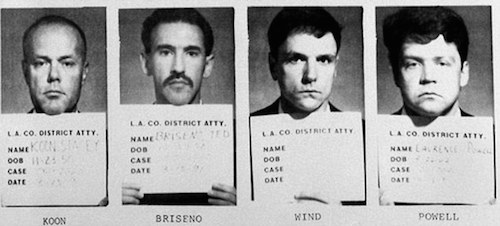
Yesterday in the Washington Post, LAPD veteran and professor of homeland security Sunil Dutta published an editorial titled I’m a cop. If you don’t want to get hurt, don’t challenge me. Black Post subscribers throughout the nation dropped their newspapers and froze. A few were shot between one and 19 times. But that wasn’t anybody’s fault, because the cops are under a lot of stress—mostly from dealing with us all day. As Dutta puts it, “It’s not the police, but the people they stop, who can prevent a detention from turning into a tragedy.” Losing my goddamned mind after the jump.
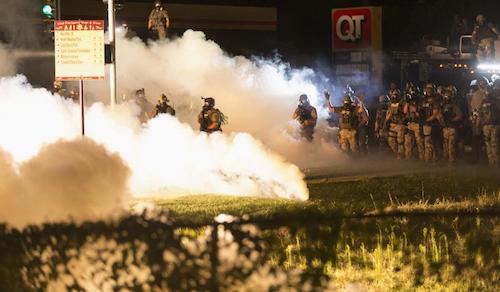
Tear gas to secure consent of governed
One way events in Ferguson, Missouri have affected English usage is by promoting the second sense of “disperse” as a transitive verb. To disperse as an intransitive verb, of course, is to stop demonstrating and go back to your homes. The most common sense of “disperse” as a transitive verb, with an object, is “to distribute or spread over a wide area.” That is precisely what the Missouri National Guard, the state Highway Patrol, and dozens of police with military equipment hope not to do with protests in Ferguson. When they disperse protesters—with tear gas or simply by making it illegal to stand in one place—they do it in the second, less common sense: to “cause to go in different directions.” The protest does not disperse; it gets dispersed, but the word retains a savor of consent.
Freedom isn’t free, also does not mean free
Remember when the word “freedom” described the power to act without restraint and not, you know, whatever else the speaker might like? Me neither. I know I said I’d never forget, but I said that all the time back then. Anyway, “freedom” now refers to what we get for being American, plus aspects of American culture such as commerce, religious devotion, muscle cars, whatever. It’s a rhetorical trope. In the 21st-century United States, saying “freedom” will hypnotize a small percentage of your audience, much as you could manipulate people during the occupation of Paris by humming La Marseillaise.
Friday links! Old friends edition
What would we do without our friends? I’ll never know, because my friends are thoughtful and compassionate and ensured that I did not spend an evening alone in New York all this week. It was great, and one way I know it was great is that I hardly looked at the internet at all. Luckily for us, my friends outside New York are great, too. They sent me a steady stream of interesting articles, which just goes to show that you should stop following the news and do what my brother says. Today is Friday, and I get by with a little shelf for my pens. Won’t you enjoy support beyond your merit with me?
Naked bike ride draws near, signaling end of morality, freedom
Missoula’s Bare As You Dare nude bike ride is this weekend, and debate has finally reached its most mature form, with each side accusing the other of not being from here. We’ve also seen the familiar trope of someone claiming that another person’s ostensibly immoral behavior infringes on his rights. Here’s Missoula financial advisor and naked cycling opponent John McFarland:
There is also my right to free speech and my right to be on public property. And for those that say, ‘Well, if you’re just not interested, don’t go,’ that’s infringing on my rights to be at a public area at a certain time. That’s illegal. So she’s discriminating against me because of my beliefs.
There it is. Another person who does something you don’t want her to do is discriminating against you based on your beliefs. If she weren’t such a discriminator, she would do as you say. You can probably guess my opinion of this sort of busybody behavior, or you can read about it in my latest column for the Missoula Independent. We’ll be back tomorrow with Friday links, fully clothed.