Nebraska bill would make drug tests a condition of welfare

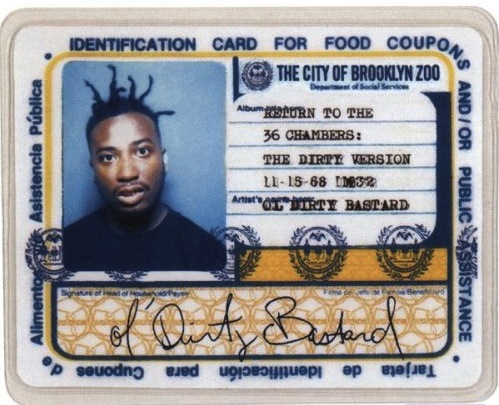
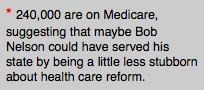
Alert reader Zach Sanderson sent me this article describing a proposal in the Nebraska legislature to tie welfare benefits to drug testing. Introduced by Senator Charlie Janssen of Fremont—population 26,000—the bill would require new applicants and current recipients of public assistance to submit to random tests, as authorized by the 1990 congressional overhaul of the federal welfare system. “When a taxpayer gives assistance to somebody, it’s assistance so they can get back up on their feet,” Janssen told ABC. “It’s kind of a slap in the face to the taxpayers when they say, ‘We’re going to get up on our feet while we’re doing drugs.'” Janssen makes a good point, whose incisiveness is dulled only slightly by its being echoed from every barstool in the country during tax season. In 2006, Nebraska spent just over $2 billion on welfare—which includes food stamps, housing assistance and Medicaid, but not, somehow, Medicare, college scholarships or farm subsidies—to support 320,000 recipients.* Surely, some of those people are wasting taxpayers’ hard-earned money. Unfortunately, administering drug tests to all of them—at an average rate of $42 per test, according to the Department of Education—would cost the state $13.4 million, and that’s just to do it once. Janssen himself admits that the costs of testing would, at least in the short term, make his plan unworkable. “This is part of our budget woes…paying people who aren’t truly trying to rehabilitate themselves and get off the state welfare system,” he said. “But the short-term cost right now is probably going to be overwhelming.” Which raises an interesting question: what, exactly, do we spend money on welfare for?

Continue reading

Friday links: Party like it’s 1899 edition

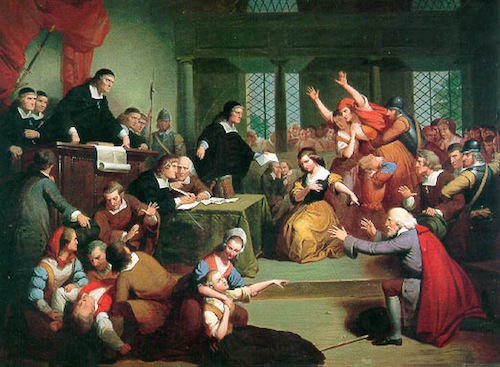
Forget all the trends you thought defined the last year—hope, resentment of the federal government, economic insecurity, reactionary populism, the baffling and continued popularity of Uggs. Put them out of your mind. All of those are as raindrops against the windowpane, noisome in announcing their impact but evaporating with any light. No, there’s only one trend that defines the current American moment, and that’s nostalgia. In a single 5-4 stroke yesterday, the Supreme Court returned us to the age of the Robber Baron, declaring that the government cannot legally restrict spending by private corporations on political elections. It was a victory for any American who feels that large corporations don’t exercise enough influence over US politics, by which I mean direct descendants of Cornelius Vanderbilt. The rest of us had best wax up our mustaches and roll up our sleeves, because the next hundred congressional and presidential candidates who imply that there should be some sort of law limiting how long we must work or how little we can be paid are going to have the sum GNP of our great nation directed against them. But a longing for the good old days of outright corporatocracy isn’t the only nostalgia sweeping the country. All week, people have been judging, arguing, organizing and reasoning using the tools available to us in the nineteenth century, by which I mean primarily racism, religion and old-fashioned stupidity. Won’t you join me in criticizing them, before the Supreme Court rules that publicly doing so constitutes an unlawful restraint of trade?

Continue reading

Being cool: People should want to kill you

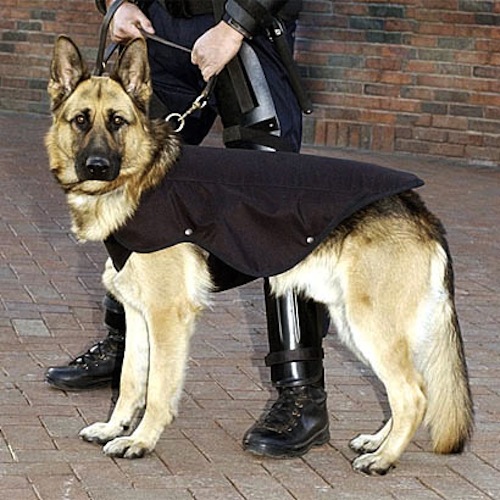
The second coolest dog ever (Number one: Phife Dawg)

In keeping with its tradition of covering the news not just as it happens, like most papers, but also possibly before it happens, the Style section of the New York Times announced today that bulletproof vests are totally hip. The author of the article, Ruth La Ferla, says the phenomenon was likely spurred by the return of the Fox show 24, in which Jack Bauer often wears a bulletproof vest. I guess that’s possibly true—24 is a show on television now, and people are apparently wearing bulletproof vests for fashion now—in the same sense that eating breakfast makes it get lighter outside. As is usually the case with a style piece, you can’t prove it’s not happening. La Ferla points out that bulletproof vests are worn by counterterrorism operatives and wealthy plutocrats, as well as Hollywood moguls and 50 Cent. “So it may have been only a matter of time,” she writes, “before aspiring hipsters embraced the style — the sartorial equivalent of a safe room — as a badge of cool.” Because as any hipster will tell you, no one is cooler than 50 Cent, unless it’s the guy who runs Wuhan Steel Group.

Continue reading

Dems lose Massachusetts Senate seat; health care ruined; sun rises in west; dogs talk backwards and demand driving privileges; mass hysteria


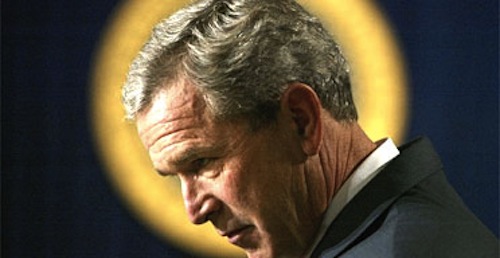
The Kennedy Curse has struck again: a mere forty years into his Senate term, Massachusetts Democrat Ted Kennedy was felled by cancer in August, leaving his seat open to a special election that took place yesterday. In a turn of events that shocked any political strategist who stopped looking at opinion polls two weeks ago, Republican Scott Brown won a decisive victory over Democrat Martha Coakley. Now Washington is scrambling. The vote in Massachusetts has widely been interpreted as a referendum on the Democratic Party, health care reform, President Obama, and the existence of American liberalism in general. It’s a little early to say, but most analysts agree that the whole thing is basically over. “It is a mighty blow for a president,” says CNN political editor Mark Preston, “who just one year ago seemed unbreakable, unstoppable, unbeatable.” By one year ago, Mark Preston, do you mean the day he took office? Yeah, I guess he did look pretty good then. Those days are done, though. That day, I guess.

Continue reading

Et in Arcadia ego: Bible verses on military gunsights

ABC News reported yesterday that Michigan gunsight manufacturer Trijicon is inscribing references to Bible verses on sights it’s supplying to US troops in Iraq and Afghanistan. The company, which has a $660 million contract to provide illuminated targeting reticule systems to the Marine Corps, has been printing chapter and verse numbers at the end of their serial numbers—for example, “2COR4:6,” which refers to the verse in Second Corinthians, “For God, who commanded the light to shine out of darkness, hath shined in our hearts, to give the light of the knowledge of the glory of God in the face of Jesus Christ.” Contemporary theologians have historically interpreted that verse as being about using hydrogen isotope phosphorescence to shoot an Afghan goatherder in the face.

Continue reading