The dog that caught the car: Postmortem on the National Tea Party Convention

"The Tea Party movement has no leader, and neither did the American Revolution." —Conservative talk radio host Phil Valentine, addressing the convention

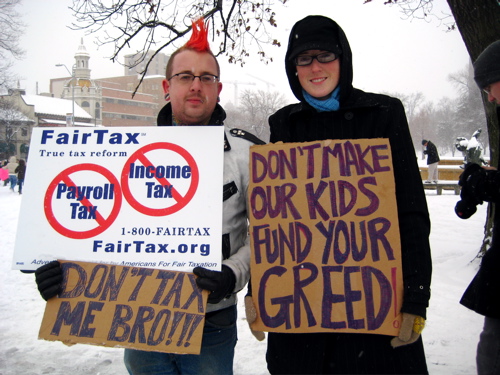
The National Tea Party Convention took place in Nashville this weekend, and the only thing anyone seems able to agree upon is that it did actually occur. Considering the preliminary disputes over the ethics of holding a political convention for profit, whether it was really national, and whether the Tea Party even exists as a single entity, the “[National] ‘Tea Party’  <finger quotes>Convention</finger qutoes>” was a huge success. The Tea Partiers successfully established that they love Sarah Palin, who announced weeks ago that she would be paid $100,000 to speak at the event, but also wrote in USA Today that she “would not benefit financially for speaking at this event…any compensation for my appearance will go right back to the cause.” What “the cause” is remained unclear to everyone. Once again, the Tea Party boiled but failed to coalesce, and the convention that we at Combat! blog hoped would finally define the movement—as a national party, an activist agenda, or even a political platform—turned out to be another exercise in playacting. ABC News captured the mood best: “Delegate William Temple from Georgia, who was dressed in a kilt, said he wanted to work against ‘Republicans, Democrats and Independents who have been in Congress too many terms. We’re sick of everyone.'” Thus spake the petulant ignorance of a generation.

Continue reading

Hey, how’s that third party coming along?

Okay, even I can't disagree with that plank of the platform.

Here’s a head-scratcher: Say you’ve got a nascent political party—it’s got a name and everything—comprised of people primarily unified by their distrust of politicians. Your party is the culmination of a grassroots movement, a coming together of regular folks who are sick of the kind of people who relentlessly grasp at power. You’re going to remake the country you love, by doing away with top-down leadership, the arrogance of office, exclusionary parliamentary procedure and stultifying bureaucracy. It’s a revolutionary movement! So, um, how do you decide who runs it?

Continue reading

Stronger than reason: David Brooks on the Tea Party

Dear god, please let there be a punk rock branch of the Tea Party.

He’s been wrong before, but when David Brooks says you’re a nationwide movement, you’re either Soccer Moms in the 2004 general election or a real thing. In Monday’s New York Times, Brooks alleges that the Tea Party movement is the latter. After opening with his usual overview of the prevailing sociopolitical winds for the last thirty to 100 years, he gets to the money shot. “Every single idea associated with the educated class has grown more unpopular over the past year,” he writes. For the moment, Brooks has declined to enumerate which instruments he uses to measure the popularity of ideas, but he at least sounds right. “The educated class believes in global warming, so public skepticism about global warming is on the rise,” he says. “The educated class supports abortion rights, so public opinion is shifting against them. The educated class supports gun control, so opposition to gun control is mounting.” Those committed to responsible argument will object to Brooks’s questionable use of the word so, which makes his theory the cause of his evidence, but as and statements his list still draws an unsettling connection. When Brooks points out that the Tea Partiers are defined by what they are against, and that most of what they are against can be grouped under “the concentrated power of the educated class,” he introduces a framework as useful as it is terrifying.

Continue reading

Daily Show articulates Tea Party platform exactly

The Daily Show With Jon Stewart Mon – Thurs 11p / 10c
Highway to Health – Last Tea Party Protest of the Year
www.thedailyshow.com
Daily Show
Full Episodes
Political Humor Health Care Crisis

The video above is from last night’s Daily Show, in which John Stewart assesses the final Tea Party protest of the year. First of all, I think it’s high time we acknowledged that the Daily Show pretty much performs all the functions of Combat! blog, plus a bunch of other stuff, and does all of it better. They are the Facebook to my Twitter. Second of all, after months and thousands upon thousands of words speculating on just what it is that the various Tea Party protestors have in common, John Steward has pinned down the species in one four-minute video segment. In so doing, he also assembles a pretty good list of differences between them and an actual political party. To wit:

1) They confuse goals with policy. At the 2:01 mark, Rick Scott says “we” don’t want more government or increased spending; we just want lower health care costs and more coverage. I agree that it’s a terrific idea, but I’m interested to see letter B in his outline. The chant “kill the bill” is a comical instance of how not just policy-free but anti-policy the Tea Party movement is. The Tea Partiers don’t have their own bill or even a vague plan for how to address health care reform, but dammit, they’re against everything that has been done so far. When they’re not out in force specifically to fight health care reform, the most common complaint of Tea Party activists is that taxes and spending are both too high. But what specific spending do the Tea Partiers suggest we cut? By now, we’ve all seen the video where the fat lady thinks for  a few seconds before saying, “All of it.” Low taxes, a strong economy, unshakeable national security and an unobtrusive government aren’t positions; they’re values. That they’re values we all share makes passing them off as an agenda even more insipid.

2) They’re outraged at stuff that hasn’t happened yet. Since Barack Obama took office and the Tea Party movement miraculously coalesced out of nowhere/Fox News studios, no changes have been made to federal gun laws, tax structures or abortion statutes. Yet the Tea Party is animated by a sense of urgent panic over these issues. Granted, President Obama probably will raise the marginal tax rate and re-ban private ownership of assault weapons, but he hasn’t yet, just like he hasn’t converted the country to socialism or changed one whit of the landscape that Tea Partiers suddenly find so terrifying after the Bush administration. When Laura Ingraham says “First they came for the rich…” she’s either lying or describing her sophomore year in college.

3) They have no sense of historical perspective. And about Laura Ingraham’s little homily: it’s a good thing Eli Wiesel wasn’t at that anti-health care reform rally. For all their fixation on history, the Tea Party seems to have very little sense of how the lives of a bunch of mallwalkers in middle America might differ from those of colonists in eighteenth-century Boston, or Jews in 1930s Germany, or political dissidents in Maoist China. Now matter how much Congress jacks up the marginal tax rate, no one is going to be sent to a forced labor camp. The inability to distinguish between real tyranny and not getting your way is a hallmark of childhood, not of representative democracy in a post-industrial superpower.

4) They’re fundamentally anti-intellectual. “We cannot let the pen be mightier than the sword.” I’m sure that was taken out of context, but I would like to take this opportunity to personally offer to meet with this fat man and explain to him the benefits of a discourse based on rhetoric rather than capacity for extended physical violence. Does the Tea Party really believe that we as a nation should think less and act more? Probably, which is why they give me the fuckin’ creeps.

Tea Party beats GOP on three-way generic ballot

The Tea Party candidate for President in 2012. N.ah, I'm just kidding—they would never nominate a Jew

The Tea Party candidate for President in 2012. Nah, I'm just kidding—they would never nominate a Jew

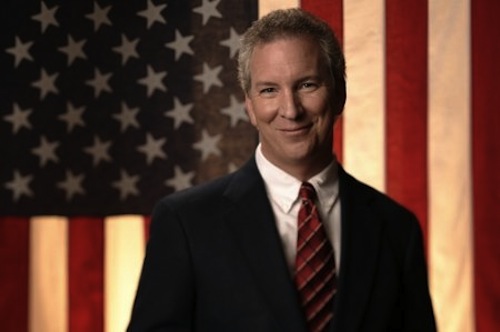
Okay, this is weird. Rasmussen Reports announced yesterday that their most recent poll shows the Tea Party beating the Republican Party by a five-point margin on a three-way generic ballot. A generic ballot pits nameless candidates against one another in a theoretical election; in this case, Rasmussen asked “If congressional elections were held tomorrow, would you vote for the Republican, Democrat, or Tea Party candidate from your district?” Democrats led the pack with 36% of the vote, the Tea Party got 23%, and Republicans finished third with 18%. Astute observers will notice that leaves 22% of those polled undecided, and also that the Tea Party does not, uh, exist. I assume the same poll found that Americans overwhelmingly reject cap-and-trade in favor of having Bigfoot drink carbon out of clouds, and want the government to stay out of health insurance so that costs can be determined by the invisible hand of David Bowie in Labyrinth.

Continue reading