Friday links! Wisdom of crowds edition

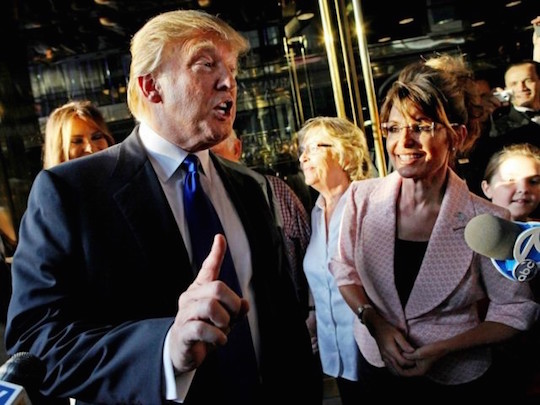
Sarah Palin tries to remember the word for that feeling you get when someone else is talking.

Sarah Palin tries to remember the word for that feeling you get when someone else is talking.

Donald Trump is the Garfield of politics: fucking stupid, but in the newspaper every day. He must be great, though, because 20% of Republican-leaning voters who responded to a Quinnipiac poll said he was their guy. That puts him ahead of both the guy who stopped the teacher’s union and the bad president’s brother. Trump has been the front runner since he announced his candidacy.There must be something about him elite media dictators like myself just don’t understand—something authentic. Something real—whatever it is, it’s definitely real. Today is Friday, and we all know the wisdom of crowds, so where does that leave us? Won’t you play the fool with me?

Continue reading

New GOP chair Essman calls for fresh ideas to criticize governor with

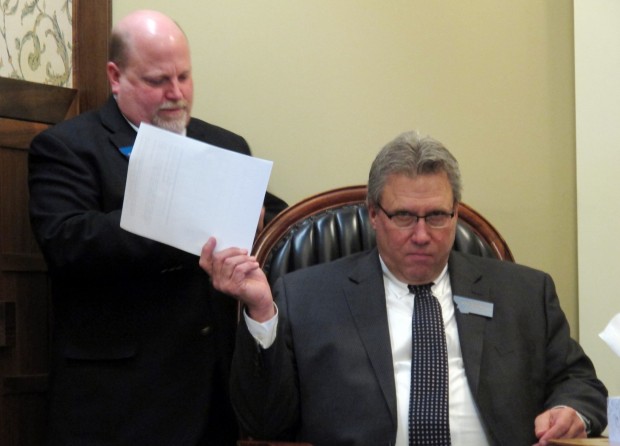
Jeff Essmann rehearses a play about a mean state senator

Jeff Essmann and Scott Boulanger rehearse a play about a mean state senator

The Republican Party of Montana elected Jeff Essmann its party chair last month, replacing Will Deschamps after six years. Essmann was president of the senate in 2015, so this move finally unites the two branches of Montana’s state government: the Republican legislature and Republican politics.

You may remember Essmann from the most wonderful email chain in the world, in which he discussed ways to reduce the power and perhaps number of moderates in his party with then-majority leader Art Wittich (now the representative from Glendive) and then-senator Jason Priest (now convicted of partner/family abuse.) Arguably, Essmann’s struggle with moderates began when he defeated Jim Pertersen in the 2011 vote for senate president. It hit a snag this past session, when Democrats joined moderate Republicans to pass Senator Ed Buttrey’s (R–Colstrip) Medicaid expansion compromise. But now that Essmann is party chair, it appears the conservatives have won.

He has a mandate. He controls the machinations of his party and the levers of the senate. And from this catbird seat, he sent an email to the state’s Republicans calling for “examples large and small” of bureaucratic failures under Democratic Governor Steve Bullock.

“It is our goal to develop a list of all these failures and begin a drumbeat of steady criticism,” he wrote, echoing the dream of ancient Greeks as they built the first democracies. You can read all about it in this weeks’ column for the Missoula Independent.

I know many of you struggle to explain why Montana politics is important to your lives—and possibly, on a causal level, it is not. But my lands, it’s entertaining. Everyone is crookeder than a dog’s hind leg and lacks the skill or the inclination to keep it secret—except for the ranchers and schoolteachers who make law 90 days every other year and take it really seriously.  The news from Helena is like a musical about trying to save the town from speculators, but without the songs. So it’s perfect. I encourage you to get hooked.

“Nothing makes us less capable of empathy than the consciousness of victimhood”

A protestor outside the Israeli embassy in Washington last July

A protestor outside the Israeli embassy in Washington last July

The bold statement in today’s headline comes from Gary Saul Morson’s essay Why Kids Are Avoiding the Study of Literature. You should read the whole thing, but I was particularly struck by his interpretation of Chekhov’s “Enemies.” Quoted at length:

“Enemies” describes a doctor named Kirillov, whose son has just died, comforting his grieving wife as his face displays “that subtle, almost elusive beauty of human sorrow.” We empathize with him, not only for his grief over his son, but also because of his empathy for his wife. It’s a chain of empathy, and we are its last link.

Then the wealthy Abogin arrives to beg the doctor to visit his dying wife, and the doctor, with extreme reluctance, at last recognizes he has no choice. When they finally arrive, it turns out Abogin’s wife has only feigned illness to get rid of her husband long enough to escape with her lover. As Abogin cries and opens his heart to the doctor “with perfect sincerity,” Kirillov notices the luxurious surroundings, the violoncello case that bespeaks higher cultural status, and reacts wrathfully. He shouts that he is the victim who deserves sympathy because the sacred moment of his own mourning has been ruined for nothing.

Nothing makes us less capable of empathy than consciousness of victimhood. Self-conscious victimhood leads to cruelty that calls itself righteousness and thereby generates more victims. Students who encounter this idea experience a thrill of recognition. Kirillov experiences “that profound and somewhat cynical, ugly contempt only to be found in the eyes of sorrow and indigence” when confronted with “well-nourished comfort,” and he surrenders to righteous rage.

Our ability to appreciate other people’s suffering is inversely proportional to our understanding of our own—not how much we have suffered, but how conscious we are of it. Self-pity might be the opposite of empathy.

Continue reading

High school student disputes scholar’s denial of “no Irish need apply”

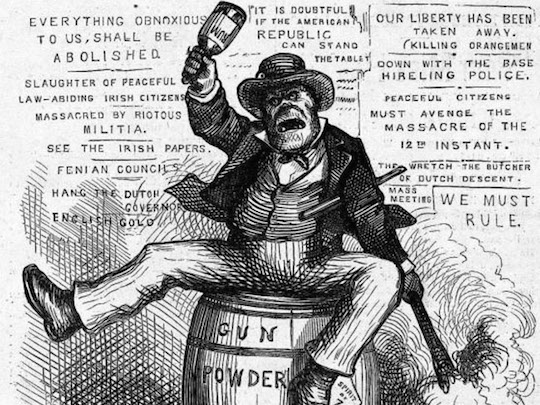
"The Usual Irish Way of Doing Things" by Thomas Nast, 1871

“The Usual Irish Way of Doing Things” by Thomas Nast, 1871

Patrick Young, Esq. is one of several to report that a high school student has disproven University of Illinois professor’s Richard Jensen’s claim that signs reading “no Irish need apply” were a historical myth. Originally published in the Journal of Social History in December 2002, Jensen’s “‘No Irish Need Apply’: A Myth of Victimization” argues that the signs forbidding employment to Irish immigrants in the 19th century were “an enhancement of political solidarity against a hostile Other; and a way to insulate a preindustrial non-individualistic group-oriented work culture from the individualism rampant in American culture.” That’s kind of a bigoted thesis, bro. Unfortunately, Rebecca Fried’s article—which is extremely commendable and impressive for a high school student—doesn’t seem to disprove it.

Continue reading

Joe Nocera calls Go Set a Watchman a “money grab” and a “fraud”

Harper Lee like 15 years ago

Harper Lee like 15 years ago

Good news for baby Atticus: Joe Nocera of the New York Times believes the recently-published Go Set a Watchman is not a sequel to To Kill a Mockingbird but an early draft. In a column Friday, he calls the book “a fraud” and “one of the epic money grabs in the modern history of American publishing.” I’d say that sounds kind of like libel, except it’s published in the New York Times, so you know they checked him.

Nocera notes that Lee spent the last 50 years insisting she wouldn’t publish another novel, “until now, that is, when she’s 89, a frail, hearing- and sight-impaired stroke victim living in a nursing home.” Tonja Carter, Lee’s caretaker since the death of sister Alice last year, said she found the new novel in 2014. Nocera believes she actually saw it in 2011, when she participated in a meeting with Lee’s former agent and a specialist for Sotheby’s that included discussion of the new manuscript. Carter claims she left the meeting before the manuscript came up and didn’t return. Nocera says, in no uncertain terms, that what really changed—the event that brought this “new novel” to market—was Alice died.

If that’s true, it’s a sad story. Celebrated one-off novelist refuses to write another book for five decades, protected by her sister when she herself is infirm. Sister dies; greedy publisher sells early, crappy draft of novelist’s masterpiece as new novel that makes everyone hate main character.

That last part presupposes that Go Set a Watchman will overshadow or at least rival the popularity of To Kill a Mockingbird, which seems unlikely at this point. Probably, Watchman will be remembered as a peculiarity of 21st-century publishing, if at all. But it seems like a dirty trick to pull on an author who spent most of her life refusing to cash in on the success of her only novel. Maybe a perfectly lucid Lee changed her mind after fifty years, a stroke, and the death of the sister who looked after her affairs. Or maybe she is sitting in her nursing home right now, only dimly aware of what HarperCollins did to her.