
Oh, irony. You are everywhere, according to certain people and pop songs, and yet you are so little known. While the strict definitions of irony remain cleanly delineated, popular usage now refers to any experience of bitter recognition as “ironic.” The expansion of the term tells us much about contemporary America, or maybe contemporary Americans. Like its mildly retarded cousin “sarcastic,” “ironic” has become a mode of being, a way of protecting oneself from the absurdity of This Modern World via a general disdain. That’s great for the lady in your office who just discovered Failblog. For those of us who are lifelong, committed ironists, however, the expansion of “ironic” is an infuriating appropriation. It’s like how Chuck D felt about Vanilla Ice. This Friday, we present the thin edge of the wedge: stories and situations that seem almost ironic but not quite, whose categorization as “irony” moves us one step closer to the dream of considering everything ironic and thereby eliminating irony altogether. Won’t you turn human experience into a uniform putty of bland derision with me?

Author: Dan Brooks
Anderson Cooper is sick of this Bachmann lady
My new favorite micro-generic hallmark of the Michele Bachmman news story is the phrase “and then she did this.” It crops up again and again in baffled coverage from veteran reporters, and I think it captures something particular about her. What Michele Bachmann says so consistently contradicts what Michele Bachmann just said that her weirdness seems inevitable, and yet it keeps managing to surprise. After a while, her political communication takes on the sort of art-for-art’s-sake quality one sees in, say, Dadaism. It makes so little sense that you must accept it only for what it is—and then she did this. What Bachmann did this time was tell The Today Show that an anonymous woman approached her after Monday’s debate to say that her daughter got inoculated for HPV, and then she “developed mental retardation.” Is Bachmann saying that you shouldn’t vaccinate your child against preventable disease? Is she saying the HPV vaccine retards you? No—that would be irresponsible. But she is saying that “this is the very real concern, and people have to draw their own conclusions.”
The other fun thing that happened at the debate

Google search results for "rick santorum"—note that the top result is a paid advertisement, and that the neologism is beating the original.
In all the chanting for death and keeping promises to seniors, we lost track of the other exciting development from the CNN Tea Party Republican Debate. Wolf Blitzer fielded questions from Twitter, one of which asked the candidates what they were doing to attract the Latino vote. Before Herman Cain could angrily shout whom?, Rick Santorum jumped on it:
httpv://www.youtube.com/watch?v=0PH8TJeP3MI
Santorum is doing the same thing to attract Latino voters that he’s doing to get votes from outside his personal church: nothing. When I first read this quote in print media, I assumed his “illegal—I mean Latino—voters” was a snide jab. Now I’m not so sure. We are talking about the man who, at the first Republican debate, said that if—when!—Rick Santorum becomes President, “the world as we know it will be no more.” Whether he just said illegal already and had it in his cache memory or was deliberately conflating ethnic identity with false citizenship, Santorum can be forgiven, because he was pursuing the objective of the debate: messing with Rick Perry.
The Tea Party Republican debate in three juxtapositions

Michele Bachmann, one of several candidates to agree that Social Security must be reformed but kept exactly the same for the largest voting bloc in America
Last night’s Republican debate was the ninth of 53 such events between now and November 2012, so maybe it didn’t seem totally important to watch it. You can probably close your eyes and see Herman Cain railing against the reading comprehension level of US policy right now. Much like the individual Republican candidates, the Republican debates have a sameness that prevents each of them from seeming strictly necessary. Any one is like the cracker that falls out of the box of Triscuits. It’s therefore understandable if you missed last night’s debate, but it’s also a shame, because it turned out to be the Triscuit with a vague image of Jesus on it. The CNN Tea Party Express Republican Debate tells you everything you need to know about the Tea/Republican Party in three easy juxtapositions. Or one juxtaposition of three elements, which also yields three juxtapositions. Let’s just let the math/usage wash over us and watch videos.
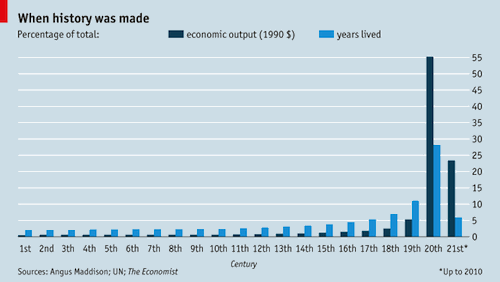
When does history happen?
My friend Tarik sent me the chart above pursuant to an unrelated thought experiment. It comes from the Economist, which compiled figures from little-e economist Angus Maddison and the UN to plot economic output and percentage of total human-years lived against centuries. A human-year is a particularly useful unit of history if you prefer the broad trend hypothesis to the Great Man Theory. As the Economist puts it, “if people do make history, as this democratic view suggests, then two people make twice as much history as one.” Fact: two people, each living 70 years, experience more human time—that is, history—than one person living 70 years. Given that the life expectancy of your typical eighth-century serf was like 28, the lion’s share of human experience has taken place in the last century.