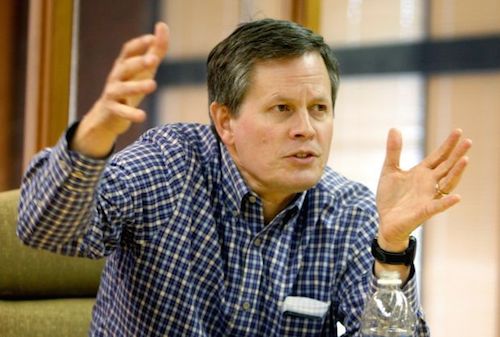
The Democratic Party of Montana has found a replacement for lurching plagiarist John Walsh: Amanda Curtis, high school math teacher and Butte resident, presumed plucky. And she is getting the full disbursement of leftover Walsh funding allowed by law: two thousand dollars. Meanwhile, an entity called the Lee Newspapers State Bureau reports that about one third of Republican Steve Daines’s $5 million in campaign funds came from within the state. That’s actually a lot for a small-population Senate race.
Author: Dan Brooks
Cop’s counterpoint: If you don’t want to get hurt, don’t challenge me
Yesterday in the Washington Post, LAPD veteran and professor of homeland security Sunil Dutta published an editorial titled I’m a cop. If you don’t want to get hurt, don’t challenge me. Black Post subscribers throughout the nation dropped their newspapers and froze. A few were shot between one and 19 times. But that wasn’t anybody’s fault, because the cops are under a lot of stress—mostly from dealing with us all day. As Dutta puts it, “It’s not the police, but the people they stop, who can prevent a detention from turning into a tragedy.” Losing my goddamned mind after the jump.
Tear gas to secure consent of governed
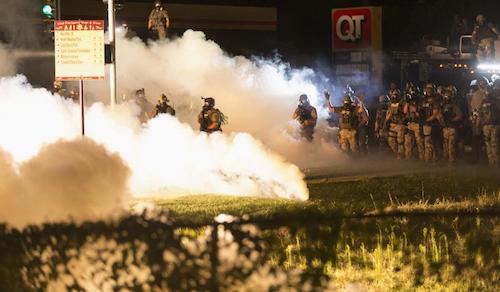
One way events in Ferguson, Missouri have affected English usage is by promoting the second sense of “disperse” as a transitive verb. To disperse as an intransitive verb, of course, is to stop demonstrating and go back to your homes. The most common sense of “disperse” as a transitive verb, with an object, is “to distribute or spread over a wide area.” That is precisely what the Missouri National Guard, the state Highway Patrol, and dozens of police with military equipment hope not to do with protests in Ferguson. When they disperse protesters—with tear gas or simply by making it illegal to stand in one place—they do it in the second, less common sense: to “cause to go in different directions.” The protest does not disperse; it gets dispersed, but the word retains a savor of consent.
Freedom isn’t free, also does not mean free
Remember when the word “freedom” described the power to act without restraint and not, you know, whatever else the speaker might like? Me neither. I know I said I’d never forget, but I said that all the time back then. Anyway, “freedom” now refers to what we get for being American, plus aspects of American culture such as commerce, religious devotion, muscle cars, whatever. It’s a rhetorical trope. In the 21st-century United States, saying “freedom” will hypnotize a small percentage of your audience, much as you could manipulate people during the occupation of Paris by humming La Marseillaise.
Friday links! Old friends edition
What would we do without our friends? I’ll never know, because my friends are thoughtful and compassionate and ensured that I did not spend an evening alone in New York all this week. It was great, and one way I know it was great is that I hardly looked at the internet at all. Luckily for us, my friends outside New York are great, too. They sent me a steady stream of interesting articles, which just goes to show that you should stop following the news and do what my brother says. Today is Friday, and I get by with a little shelf for my pens. Won’t you enjoy support beyond your merit with me?