Arkansas passes religious freedom law, because what could go wrong?

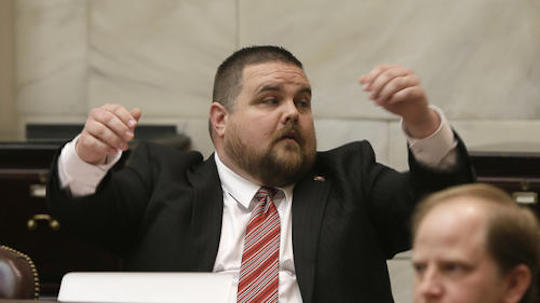
Rep. Bob Ballinger of the Arkansas House (not pictured: puppets)

Arkansas House member and sponsor of religious freedom Rep. Bob Ballinger (not pictured: puppets)

I’m not saying that if a wizard transformed all the members of the Arkansas House of Representatives into animals, Rep. Bob Ballinger (R–Berryville) would be a walrus who goes “harrumph!” But he wouldn’t be a mallard, would he? That’s because a mallard is gay, and Ballinger sponsored the religious freedom law that Arkansas passed yesterday. That law is totally not designed to let businesses refuse service to homosexuals. That would be discrimination, and that’s not what Ballinger is about. Earlier this session, however, he did sponsor another bill that forbid Arkansas towns and cities from passing anti-discrimination ordinances protecting gays and lesbians. But that’s a coincidence, owing to the widespread discrimination against Christians in America and the comparative absence of bias against gay people. Here’s Ballinger explaining to the Times why he didn’t think to clarify that his bill wasn’t about anti-gay discrimination:

“All the way through this I thought it was unnecessary because of the fact that it didn’t do everything that everybody was saying it was doing. In hindsight maybe I would have done it to maybe avoid all the pain.”

He said that a few minutes after the bill passed.
Continue reading

Pence won’t say whether law would allow discrimination against gays

A hue and cry has risen against Indiana since Governor Mike Pence signed the state’s Religious Freedom Restoration Act, which exempts individuals from laws that conflict with their sincerely held religious beliefs. Critics say it amounts to legalizing discrimination against homosexuals. Pence called that claim “a smear” and insists the law merely reiterates the federal Religious Freedom Restoration Act of 1993. In the interview with George Stephanopoulos above, however, the governor refused to say whether it would be legal for a Christian florist in Indiana to refuse to serve a gay wedding. He refused repeatedly. Stephanopoulos’s vain attempt to get him to answer yes or no begins around 1:25 and continues for four minutes, during which Pence hedges like a damn juniper. He simply will not say whether Indiana’s bill legalizes discrimination.

Continue reading

Close Reading: MT House rejects religious freedom bill on 50-50 vote

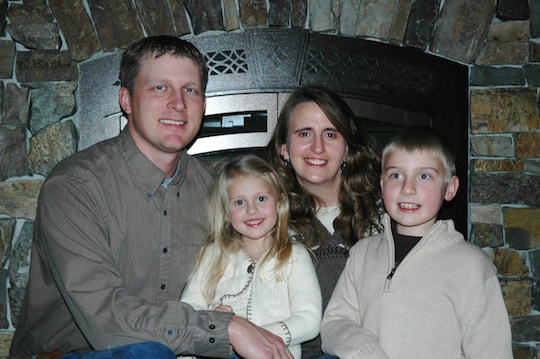
Montana Rep. Carl Glimm (R–Kila), his family, and their ideological clarity

Montana Rep. Carl Glimm (R–Kila), his family, and their certainty

Last Thursday, Indiana passed a bill authorizing business owners to refuse service to gays and lesbians based on sincerely held religious beliefs. The state immediately became a laughingstock. I guess laughingstock is the wrong word for this civil rights issue; Indiana became a cryingstock, or maybe just a boycottingstock. Regardless, it was a disaster. The very next day, the Montana House took up its own religious freedom bill, sponsored by Rep. Carl Glimm (R–Kila.) That bill failed on a 50-50 vote, after a contentious debate that saw Glimm brandishing his camouflage Bible on the House floor. He also said this:

[The U.S. Constitution] is the word of God, and the First Amendment says I have freedom of religion, not freedom from religion.

Literally no part of the sentence is true, and yet it tells us so much. Close reading after the jump.

Continue reading

Friday links! Good-enough Morgan edition

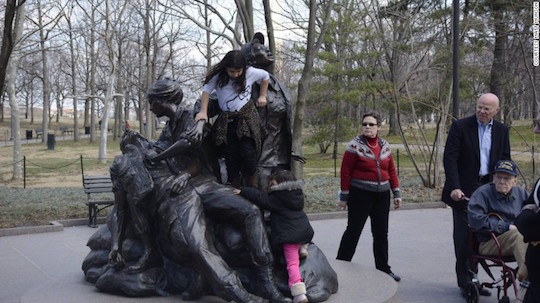
Children climb on the Vietnam War women's memorial in Washington, DC.

Children climb on the Vietnam War women’s memorial in Washington, DC.

I learned a sweet expression yesterday: good-enough Morgan, an issue or talking point used to influence voters temporarily, particularly in the period before an election. For example, gay marriage became a good-enough Morgan in 2004, driving evangelicals to the polls so they would vote for George W. Bush and then vanishing from the national Republican agenda. But the best part of “good-enough Morgan” is the etymology. William Morgan was a former Freemason who planned to write a tell-all book before his mysterious disappearance in 1826. When Thurlow Weed, organizer of the nascent Anti-Masonic Party, found a body floating in the Niagara river in 1828, he said it would be a “good-enough Morgan” until after the election. Today is Friday, and the people must be tricked into wisdom somehow. Won’t you misidentify the bodies with me?

Continue reading

Missoula water system is a wreck in court but a deal in committee

Missoula Mayor John Engen

Missoula Mayor John Engen

Here’s a fun fact: Missoula is the only major city in Montana that does not own its water system. Mountain Water is owned by the Carlyle Group, a $35 billion private equity firm that purchased the utility in 2011. One condition of the sale was that Carlyle would entertain purchase offers from the city in good faith, but it has since rejected all of them—possibly as a result of ideological objections to public ownership among its executives. Under Mayor John Engen, the city has tried to buy Mountain Water for the last year, only to meet vigorous resistance from The Carlyle Group, which has simultaneously arranged to sell to Algonquin Power. It’s a tangled web, and last week the city took Carlyle to court for condemnation proceedings—a process originally projected to cost $400,000, whose combined legal fees now stand at $2 million.

That’s okay, though, because Mountain Water is a deal at any price. That’s been the city line all year, but last week an expert witness hired by same testified that the system could need as much as $95 million in capital improvements to meet industry standards. That’s more than the total purchase price we offered Carlyle last year. The more Missoula argues in court that Carlyle has mismanaged Mountain Water, the less it seems like a great idea to buy it. That’s the gist of my column in this week’s Missoula Independent, which is some hardcore local stuff but still of interest to those of you who like to see how small-town politics work. Basically, how it works is that the most charismatic dude in the city comes up with a plan, and we follow him into what is hopefully an elysian future. Or it’s a public debt dystopia—we’ll find out when we get there.