
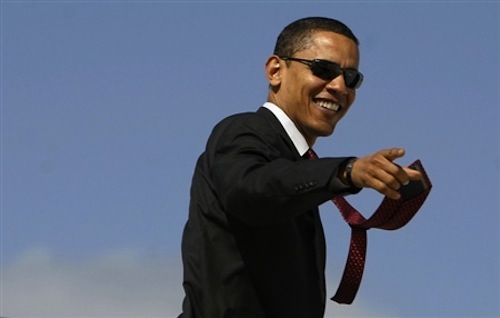
Every schoolchild knows that the Founders built American government on a system of checks and balances, by which the executive and legislative branches battle each other for eventual control of the military judiciary. Starting around January 16, 2009, it looked like Congress was winning. There are a lot more of them, so they enjoy the same advantages over the President that gazelles enjoy over lions: anonymity and coordination. Meanwhile, the United States of America hurtles toward doom and bread riots—that’s the consensus, at least—so Congress need only stall this position and wait. They’re like mutineers who decide to kill the captain and next conclude that the best way to kill the captain is to sink his ship. So picture 535 gazelles and a lion fighting in the control room of the Bounty, and that’s our government for the last three years.
Tag Archives: obama
Friday links! Spectrum of intentional hilarity edition
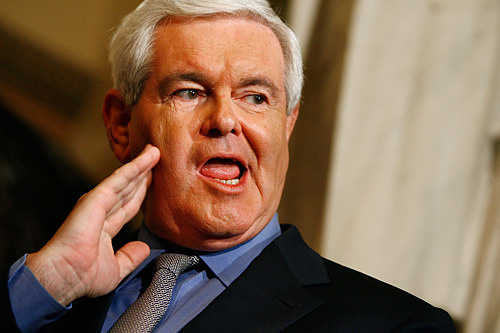
It is generally better to do things on purpose, but there is something about the unintentional that can redeem almost any act. Boethius argued that the essential crappiness of life—here we note that he was a 5th-century Ostrogoth, so he should know—could be mitigated by philosophy, that the creation of new meanings could repair awful events. Fifteen centuries later, Camus would take a similar position in his formulation of the absurd. Humans are the animal that observes and interprets. By observing, we recreate other people’s actions free from their intentions, and by interpreting we create a conjunctive world less stupid than the one we’ve got. Or at least it’s funnier. This week’s link roundup runs a spectrum of weird hilarity from the deliberate to the sublimely accidental. Of course we’re starting from the not-entirely-on-purpose end. Newt Gingrich’s terrifying psychosexual ambition after the jump.
Ladies and gentlemen, a straw man
I should warn you right away that today’s post is probably a variation on what Richard Hofstadter called the paranoid style in American politics. I mean the style, not the essay. Yesterday, the White House withdrew its threat to veto S. 1867, the defense authorization bill that provides for (A) annual Pentagon funding and policy directives and (B) the indefinite military detention without trial of American citizens suspected of aiding terrorists. See, it does two things. But don’t worry—the White House has concluded that:
the language [in Sec. 1031 of the bill] does not challenge or constrain the president’s ability to collect intelligence, incapacitate dangerous terrorists, and protect the American people, and the president’s senior advisors will not recommend a veto.
Press Secretary Carney’s remarks were interrupted when a bunch of crows got scared and flew away.
Regarding shame
As a lazy, dishonest person, I appreciate the value of shame. Take this blog: were it not for the literally several of you who expect a post each weekday, I would probably wake up early and excuse myself from writing almost every morning. Fortunately, I find time in the day to do that anyway, but my point is that shame is a powerful motivator—for me, at least, and I suspect for a lot of other people, too. One of the aspects of conservative orthodoxy I actually agree with is that our contemporary culture exerts dangerously low amounts of shame. I totally disagree with conservatives about where that shame should be placed; we still exert way too much shame on gay people and immigrants, for example. That’s valuable shame that could be more effectively directed elsewhere. Maybe, as Thomas Edsall suggests in the Times, we could redirect our shame at people who make obviously false and/or misleading statements to the general public. Earlier generations called such statements lies.
Force the White House to talk to you with petitions
Here is something amazing that the federal government is doing right now: if you put together a petition with 5,000 signatures, the White House will respond to whatever that petition asks. It’s like praying, if god actually existed and/or cared what people thought about him. At a time when a lot of people think the United States has strayed from Constitutional principles, this program is an unprecedented realization of the First Amendment. The people have the right to petition the government for a redress of grievances—something that almost never works when you do it via an actual petition, which is to contemporary politics what asking for a snack machine in the cafeteria is to student council. Nobody with a letter after his name has given a rat’s ass about petitions since the Sherman Act, until now. The good news is that this new program is very well-timed, since the internet has made the logistics of petitioning easier than ever. The bad news is that the two petitions answered thus far have 1) asked the President to legalize marijuana and 2) demanded that the federal government acknowledge the existence of extraterrestrial life.