The Transportation Safety Administration has made great strides in the past nine years, developing from a new and disorganized federal agency to a fine-tuned machine that has nearly stopped several terrorist attacks. Only two master criminals have been devious enough to breach its defenses—the Shoe Bomber and the Underwear Bomber. To critics who would indict the agency on these counts, I say: everyone who has messed with the TSA has had either his feet or his testicles burned off.
The TSA has anticipated virtually every method of terrorist attack that has already happened, and at this point the only thing left to do is fine-tune the system. It was in that spirit of helpful inquisition that I performed an experiment this morning, in order to answer a pressing question: How prepared is the Transportation Safety Administration to address the very real possibility of fifteen Amish people and a pomeranian?
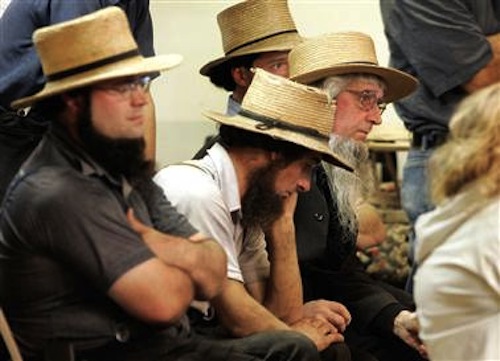
This issue is of pressing importance to all Americans, with, ironically, the possible exception of the Amish. “What the fuck is a TSA?” they will ask you, or they would if they were not so busy starting in complete bafflement at the touch screen self check-in kiosk. The Amish people in my experimental group had arranged themselves in what appeared to be hierarchical order, with the men in a wedge at the head of the line, followed by their wives, followed by what appeared to e women of marriageable age, followed by children. I stood behind the children and the pomeranian, in the control group.
Hypothesis: It will take a long time for the TSA, working in conjunction with Northwest Airlines, to process fifteen Amish people and a pomeranian.
The Amish men stood around the self check-in kiosk, gesturing at the screen and discussing, using careful logical argument that sometimes addressed the manner in which a thing can be known, whether they were flying on Northwestern or Delta. The test of patience was, from my perspective, herculean. Do the Amish regard a touch screen self check-in kiosk as sinful? Had they even known before they left for the airport that such a thing existed, or were Amish men constantly having to make quick judgments about which instances of modern technology would draw them into a decadent, godless hell on earth? You know, like, at the airport? Several of the men had gathered around a kiosk that they appeared to be not using, or using at a speed just below that of the other Amish men at which all molecular motion had stopped. I asked one of them if he was still working.
“Oh no,” he said, jumping back from the machine as if it were a complex piece of electronic telecommunications equipment and he was a man who regarded zippers as vaguely evil. His face took on an expression of bitter humiliation. “I’m so sorry,” he added.
Oh god! I had hurt the feelings of an Amish person! I grinned at him stupidly, trying to convey with my facial muscles a profound respect for his value system and deeply religious, possibly apocalyptic worldview. At this point we embarked on a jovial, nonthreatening exchange of small talk, which he conducted with the serenely terrified demeanor of a man who believes the person he is talking to might start masturbating to pornography on his cell phone at any moment. Other Amish men milled around the ticketing area, loudly engaging in extremely polite small talk with anyone who made eye contact with them. They smiled and nodded and made nonthreatening, ultra-friendly gestures at everyone, the way you would if you crashed the space shuttle and got out and saw a bunch of octopuses holding sticks. Amish children began to drift toward the security tables, where TSA guards began shouting instructions at them immediately. Was this their first experience with modernity? A man with a gun and rubber gloves yelling “keys, wallets, cell phones” while they wondered frantically what those things might be?
In the event of fifteen Amish people and a pomeranian, it is critically important that you be one of the first people through security. I pretty much ran to the screening area, pushing aside children who had never known violence or even velcro shoes to arrive ahead of the Amish, but behind the pomeranian.
“He’s a very special boy,” said a woman who looked, god love her, very much like a pomeranian. The mildly insane dog owner who looks like her dog is such a familiar cliché that encountering one in real life turned out to be extremely depressing, like accidentally hiring a sassy gay wedding planner. The pomeranian looked exactly like every other pomeranian I had seen, with wild, vacant eyes and pointy little white teeth. The woman launched into an explanation of the different things the pomeranian liked and disliked, and the reasons why he found it unpleasant to fly, and the effect of this speech was to send me untying my shoes and throwing my belt into the dish and otherwise preparing myself for security with greater speed than ever before.
“You look like you’re rushing, sir,” the TSA lady said.
“New record!” I said cheerfully, eyeing the wall of Amish bearing down on us as I emptied my pockets. “Personal best!”
At that point I was taken aside, frisked and interrogated while employees of the Transportation Security Administration emptied my bag, which contained several articles of clothing with zippers on them, a book with a swear word in the title and two very old condoms, all of which was spread out on the table before an audience of Amish eight year-olds. By the time I got to the metal detector, the Amish were milling about with their shoes in their hands in abject confusion, and the remainder of the security screening process lasted for the next ninety minutes.
So the TSA is indeed prepared for fifteen Amish people and a pomeranian, in that even in the face of great cultural and, in some cases, biological differences, they are still able to identify who the craziest person trying to get on the plane actually is. While one might criticize their efficiency, their thoroughness is beyond question, and the extra hour and a half I spent in security was worth it to know that I was, for once, safe from myself. The delay turned out not to be a big deal anyway, since my flight was cancelled.
“Yip,” said the pomeranian. “Yip yip yip. Yip yip yip yip yip yip yip.”
“Cooper,” the woman said sternly. Cooper looked quizzically at her, then continued barking for the next several hours.