Semiological problem: Williamsburg-themed cigarettes

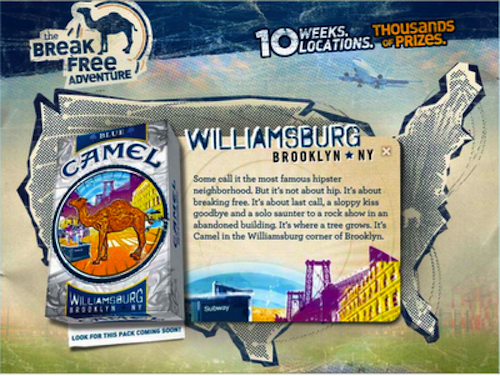
Promotional material for Camel's new Williamsburg-themed cigarettes. No word yet on dogs and cats living together.

In what is surely the third most infuriating development of the last year, the RJ Reynolds tobacco company has begun marketing a brand of Camels to Williamsburg hipsters. The packs are being sold as part of a national campaign associating Camel Blues—née Camel Lights—with Austin, the Haight, and other ostensibly hip American locales, and feature everyone’s favorite cigarette-smoking horse in front of the Williamsburg Bridge, a New York subway stop and the facade of what appears to be a SoHo warehouse. The second most infuriating development of this year is this lead from the Observer article: “You’re just another rebellion-minded young kid with ambitions to be like one of those people you associate yourself with. That’s correct, you want to be a hipster.” I defy you to comprehend that sentence on the first try. The most infuriating development of the year is that people are actually buying these things. Once again, the concept of the hipster rears its two, bickering heads: one a risible and obvious construction designed to sell cigarettes, blog posts and copies of New York magazine, the other a phenomenon that is evidently real, if only a real illusion.*
Continue reading

“Bill, I know football, man”

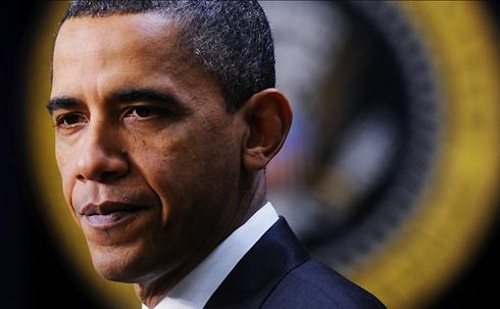
I spent the hours before the Super Bowl stuffing wings in my mouth as fast as I could, so I missed this Fox News interview with Barack Obama conducted by Bill O’Reilly. That’s probably just as well, since the sight of me sputtering wing bits onto the screen was best left for, um, the first interception.* A lot of people are afraid to interrupt the President of the United States so they can finish his sentence, but O’Reilly is not a lot of people. He is one irritatingly smug person, who responds to an invitation to the White House by saying “I don’t want to ruin the party for you guys” and routinely follows the President’s opinion by offering his own. After Obama finishes explaining his position on the Muslim Brotherhood’s participation in a representative Egyptian government, O’Reilly adds, “Those are some bad boys. I wouldn’t want those guys anywhere near the government.” Somehow, the President manages not to say, “Maybe that’s why no one ever elected you to do anything, you jackanapes.” The whole interview is a study in restraint, except for one moment near the end. After he has been accused of socialism—after he has been told that his close friends think his personality has changed and asked if it bothers him that people hate him—the President loses his composure when O’Reilly suggests that he doesn’t understand football.

Continue reading

Shameless self-promotion Monday

httpv://www.youtube.com/watch?v=u00XbTH4QZw

Behold the second episode of Hearts and Brains, here in place of some more useful thing that you were probably expecting to see! The monocled industrialists at Coca-Cola bought up all of Machinima’s promotional space for Super Bowl weekend, which means that this puppy is going to be watched on the strength of its virulence or not at all. If you have a moment and know someone who thinks zombies are funny—and also does not think that jokes about dead hookers perpetuate permissive attitudes toward violence against women*—please make them watch it. Kevin “Xanatos” Cianek did a phenomenally smooth job of animating this thing, and Ben Gabriel’s voice acting is terrific as always. It would be a shame for their hard work to go unnoticed, and for my constant refreshing of the YouTube page to feed my depression spiral rather than ameliorating it. Watch it! Share it! Leave me to die!

Friday links! You, sir, are my nemesis edition

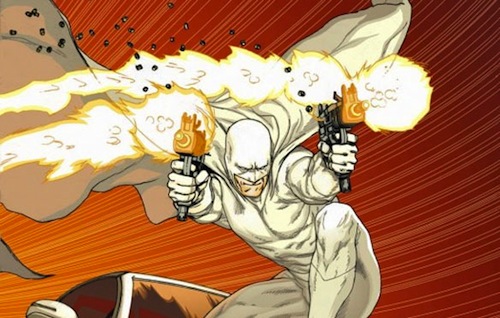
Mark Millar's Nemesis, ironically one of the lamest supervillains ever

Superman has Lex Luthor; Clarence Darrow had William Jennings Bryan; I have whomever just met me at a party—everybody needs a nemesis. An opposite number gives definition and continuity to your life, like the page around the print. If you have no enemies, you’re forced to suspect that you aren’t doing anything worth thwarting. Fortunately, contemporary American culture is chock full of nemeses, given as it is to arranging every concept and endeavor around a series of dialectic* opposites. Most of those people are famous, which, for the normal person, makes the process of selecting a nemesis somewhat daunting. But that’s the beauty of nemetry: because it is, by definition, a reciprocal relationship, having a famous nemesis immediately situates you on the continuum of fame. Just look at Glenn Beck, whose inchoate hatred for the President has made him a figure of national attention. Or, better yet, look at the infuriating video of Bill O’Reilly after the jump, and feel your anger elevate you to the level of irrational commentator, too, if only in the form of yelling at the screen.

Continue reading

This week in disenfranchisement: college students

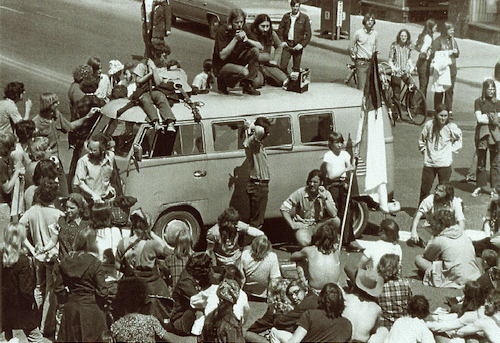
Dirty hippies moan around their crap bus.

If you live in a college town like I do, you’ve probably noticed that the streets go unpaved and everyone pays exorbitant taxes so the state can give free abortions to black girls. That’s because all the students overbalance the electorate, forcing real, over-25 human beings to cow to their agenda of ignorance and, I dunno, socialism. College students don’t know anything about politics. They may live in one town for four to six years, but they don’t actually live there, because they’re too busy swallowing live goldfish and listening to raps. They’re not real people, which is why they should only be allowed to vote wherever they came from—presumably where their parents live. That’s the reasoning behind House Bill 176 in New Hampshire, which would bar college students from voting in the cities where they attend school, and Republican opposition to HB 130 in Montana, which would have expanded voting by mail.

Continue reading